Friday, August 07, 2009

Khorog to Afghanistan-

6-4-09

It was an incredible relief to finally be in Khorog. The van ride was easily the most uncomfortable 30 hours of my life. I was consumed with euphoria and adrenaline as I began making my way down the crowded dusty road toward the center of town. Toby was easily as exhausted as I, but in good spirits due to our recent escape from the soviet cage we had been imprisoned in.

Khorog reminded me a lot of Sarajevo: it being an isolated oval shaped town engulfed with high mountains in all directions, and also being a town that has seen its share of conflict in the last 20 years (mostly civil). Khorog, despite its unlikely location is an incredibly young and educated region of Tajikistan. It hosts several universities and has seen the benefit of a substantial amount of development money from the Aga Khan Foundation.

With a bit of help from some friendly locals, my brother and were able to find a relatively comfortable home-stay near the center of town. It was situated within a cluster of mud houses not far from the main road. We were provided electricity, warm meals, and even a makeshift western style toilet (an outhouse with a real ceramic toilet above the hole). Electricity was pretty much standard in the area thanks to Tajikistan’s major industry (Hydro-electric power), but plumbing was pretty much non-existent. Unfortunately the Tajik’s, due to hard economic times and an incredibly unstable privatization/independance period, the Russians have bought up much of their Hydro-Electric industry.

Exhausted yet powerfully euphoric with anticipation, we spent the evening sorting out logistics in a nearby Russian restaurant. As night fell, stress and uncertainty weighed heavy on my body and mind, but with a belly full of borsch and Tajik vodka I slept like a baby.

-I should note that during my short time in Khorog, I came across no fewer than five Tajiks, women and men, who were missing one or both legs. I of course cannot be certain of the cause of these particular injuries……..but I am willing to assume that they were all victims of land mines left in the area during the soviet invasion of Afghanistan. Along the Der-yoi Panj river which provides a natural border with Afghanistan for hundreds of miles, land mines lay dangerously hidden in forgotten locations throughout the area. Though many specific areas are marked with warning signs……….it is no surprise that innocent shepherds continue to fall victim to these lingering, indiscriminate capsules of hate.

6-5-09


Off to Afghanistan-

At 8am Toby and I hired a Russian jeep (Lada-Niva) to take us to the small southern border town of Ishkashem. The three hour river route heading south to Ishkashem was amazing. Rusting shells of Soviet Tanks littered the roadway and provided a stark reminder of the Russian invasion of Afghanistan in the 80s. Separating Tajikistan from Afghanistan along the west side of the road was the Der-yoi Panj river, historically known as the Oxus. High snow peaked mountains lay jagged and bare on both sides of the windy road toward Ishkashem. Glancing across the river into Afghanistan provided a fascinating spectacle; shepherds and farmers were living in desolate caves along the steep rocky mountainside. Crops were being sewn into seemingly barren fields high up the steep mountainside. I grew more fascinated and energetic with each passing minute. We were entering a desolate, high elevation area with a smorgasbord of cultural purity and significance.

As we drove along the weather damaged mountain road the thin air slowly squeezed our lungs as our elevation began to increase. Desperate looking village kids as young as 3, would often swarm our jeep with red crusty faces and innocent smiles. Their tiny hands would shove large vegetables into our windows while yelling the prices at the top of their lungs with desperate passion. Our driver purchased three large mountain vegetables from a group of children, but only after haggling quite hard for a fair price. The vegetables were wrapped up like corn, had a look similar to broccoli, and a pungent smell which seamed to be a mixture between onion and garlic. The jeep reeked pretty bad after we picked up these mysterious veggies.

We passed several desolate mountain villages on our way south. Young women with bright colored head scarves, thick wool socks, pastel colored rubber sandals, and dusty velvet gowns gathered water from the nearby river with yellow plastic jugs as our jeep slowly progressed along the narrow path. These villages were far from any sort of electricity or plumbing. In fact, plumbing is something I had not seen since Dushanbe. The men generally dressed relatively modern while the women almost always wore traditional scarves wrapped around their hair. (Square skull caps identical to the Uzbeks were widely worn by men throughout Tajikistan)

{This is of course an indication of the blurry cultural boundary between the Uzbeks and Tajiks. The Uzbeks and Tajiks had always(as far as modern history goes) coexisted in the region that stretched from the Pamirs to Beyond Bukkara. During the early 20th century, the Soviets colonized Central Asia and forcefully split Turkestan into countries based on the ethnicity of the inhabiting tribes and clans. Russia had already conquered Central Asia in the late 19th century (Great Game era) but had done little more than establish control and set up trading and diplomatic posts until the Bolshevik revolution turned Central Asia upside down. Since Turkestan has historically been a nomadic territory with long established city-states, this task proved to be a challenging one. The Kyrgyz and the Kazakhs were the easiest clans for the Russians to deal with. The people of both groups are nomadic, and had never really been part of any certain city-state within Central Asia. A border was drawn………a history and culture was created, cities were built, and oppressive violence forced the nomads into relatively sedimentary lifestyles. It is probably worth noting that in my opinion there is no real difference between the Kazakhs and Kyrgyz when pertaining to culture. They are undoubtedly different clans……..but their real difference lies in the geographic regions in which they have historically occupied.

The Turkomens were also relatively easy to sort out. They are sedimentary people, whom have had a settlement carved out alongside the Caspian Sea for ages.

The major problem issues arose while the Russians attempted to sort out modern day Uzbekistan. This stretch of land contains almost all of the important ancient Silk Road city-states of Central Asia. Uzbek tribesman were undeniably the majority of the region, however the Tajiks had a strong presence in both Buckara and Samarkand and throughout various parts of modern day Uzbekistan…….enough of a presence that they are to this day quite irate about losing these cities to the Uzbeks. Sorting out Uzbekistan was a problem from day one. When the Russians drew up the borders and created the first draft of Uzbekistan…..the Tajiks were more or less ignored. The Uzbeks now officially controlled Khiva, Bukhara, Samarkand, Tashkent and the entire Ferghana Valley. Being the main minorities of the region, the Tajiks were initially given an autonomous region within Uzbekistan (1924). Then later, after a lot of bad noise the Tajiks were granted their own Socialist Soviet Republic in 1929. This of course did not erase the tension between the Uzbeks and Tajiks………….

The second problem with the split was the Ferghana valley……which is a region of Kyrgyz, Uzbeks, and Tajiks all inertwined………..cutting a border in this region needless to say has caused quite a bit of conflict. One only needs to look at a map to see the ridiculously carved borders of this region to understand how difficult it was for the Soviets to draw the line. Needless to say, all was not fair in the end, and many ethnic clans soon found themselves a minority group of the wrong country.}
Photobucket

OK, I will stop trying to create a history lesson and get on with my present explanation of my recent journey. I will mention however that the Tajiks are perhaps the only group in Central Asia that can truly claim substantial cultural and ethnic differences amongst other Central Asian clans. The Tajik Language is similar to Farci, while the Uzbeks and all other Central Asian tribesmen (including the Uigers of Western China) speak a Turkic language. Over the years, very few cultural differences have remained amongst the Tajiks and Uzbeks………..language is now the defining factor.

By the time we had arrived at the Tajik Afghan border it was noon, and the border was closed for lunch. The desolate border post was quite basic and simple….nothing more than a narrow steel bridge followed by a couple portable shacks for customs officials.

Bad vibes and mutual resentment began to thicken the air as my brother and I became aware of our close proximity to a Tajik military police check point. Unfortunately for us, the police checkpoint was located less than 100M from the border, an altercation was inevitable. Knowing that our permits and visas were in order, we were a bit more annoyed than worried about our proximity to the police checkpoint. Getting hassled, harassed, and shaken down by military police had become a familiar occurrence for us throughout our time spent in Tajikistan: {we had passed through no less than six police checkpoints in the last two days, many with officers who casually asked us for a bit of baksheesh for their troubles} . Predictably, within minutes of waiting outside the closed border, a group of soldiers approached Toby and I and demanded to see our passports. After I was forced to answer a few simple questions (in Russian), the young soldiers took our passports and walked back to their headquarters.

For two agonizing hours, we sat anxiously on wet chalky stones staring blankly into the heart of the grey flowing river below us. Rain began to pour from the sky just as a group of middle aged soldiers began walking our direction with our passports in hand. I unwarrantedly sighed in relieve.

Six roughneck soldiers with red leathery faces and bushy mustaches marched up to Toby and I with an underlining demeanor of mischief. Almost immediately I began to smell trouble; they had a suspicious and angry look in their eyes as they began berating us with questions. By the time my Russian language skills had became completely exhausted, the trouble had intensified immensely. I understood the issue, but was a bit unclear as to what exactly was going to happen to us.

-The Situation:

The dimwit at the Tajik Embassy in WA D.C had forgotten to stamp my brothers visa. And anyone who has spent anytime in former Soviet countries knows that without a stamp all documents are completely worthless.

So here we were in the middle of nowhere, exhausted, frightened and completely helpless as a group of Tajik military police relentlessly pried us about how we were able to enter Tajikistan with an invalid visa. After about 30 minutes of bad noise, the commander of the ramshackle police check point came over and in broken English began angrily explaining to us the situation.

-I was OK, my passport, visa, and GBAO permit was inline and was without problems.
-Toby was in Tajikistan with an unstamped visa, which makes it invalid
-this in essence meant that Toby was in the militarized GBAO region of Tajikistan without a valid visa…….. which was really not the ideal place to be without immaculate documents.

{the Gorno-Badakhshan region of Tajikistan tried to break away from Tajikistan during the civil war of 1992, but when the dust settled the local government of the GBAO region settled for being an autonomous region within Tajikistan.}

Toby stood motionless in a surreal state of petrified shock as the officer began explaining to us that Toby would undoubtedly be sent to jail and eventually deported. Having put hundreds of hours of planning into this journey, and come such a long way only to be shut down at the border of Afghanistan was not easy for me to digest. I spent a good 30 minutes pleading with the officers to let us through. I told them that we would be happy to pay a fine if we could simply slip into Afghanistan. I even promised that we would never return to Tajikistan if he merely allowed us to slip through the cracks of Tajikistan’s suffocating bureaucracy(my plan B was to come back in through the border above Kunduz after the Afghan Trek).

An hour later we had gotten absolutely nowhere. We were now through the gate and in the customs office, but where being detained. The sinister smirks on the officers faces made it clear to me that this was the most action that any of these men had seen for quite some time. I began to panic……angry faces, koloshnikovs (AK-47s), jail, deportation, failure, exhaustion, danger, pain, embarrassment, shame, helplessness……..what was happening..

Their crusty sunburned faces sat on their wiry frames like evil scarecrows, enjoying every minute of our discomfort and helplessness. The soldiers resented my desperation, and seamed to thoroughly support the proposed outcome of our dilemma. My brother and I had completely lost our composure and wore a thick mask of desperation and exposure. We were now at the mercy of poor, corrupt, bored, military police at one of the most desolate borders in the world.

Our bags were searched thoroughly as a series of phone calls were made by the station commander. Condescending and unsympathetic glares were directed at us as we stood like frightened puppies in the corner of the dusty steel shack. A million thoughts raced through my mind while we floated in the sea of uncertainty. My brother having very little travel experience was now in perhaps the most frightening and uncertain predicaments of his life. Would he be taken to a desolate Tajik prison while they sorted out his deportation documents? Would we be able to afford the bribes we may be forced to pay?

An agonizing hour went by before the officer stamped our passports and signaled us to start walking toward the Afghan Customs. We were told that since our visa invitations were filed in Dushanbe and our GBAO permits were inline, the military headquarters in Dushanbe had given us the OK to pass through.

It was a Friday……….so the Afghan customs officers had not returned to the post from their long lunch. We were forced to wait another 45 minutes with our tormenters before we were able to pass through the relatively easy Afghan customs and finally step foot on Afghan soil.
Photobucket
Khorog-
Photobucket
On the road from Khorog to the Ishkashem border crossing
Photobucket
Photobucket
Photobucket
I finally made it into Afghanistan. This photo was taken about 200 Meters from the border post on the Afghan side.

Friday, July 17, 2009

The beginning of the end- Journey to Tajikistan

After a quick tour of Chicago and NYC, my brother Toby and I excitedly boarded a plane heading to the world abroad. Our journey began with a quick tour of Istanbul, Turkey, subsequently followed by a relaxing couple weeks in my home away from home, Bulgaria.

I can’t stress enough how completely amazing it was to be back in Bulgaria. All the stress I had been accumulating throughout the previous ten months seemed to vanish within the first few days I was in Bulgaria. I felt at home, comfortable, and exceptionally happy. I was able to reconnect with my host family, old friends, and my former colleagues from the Municipality of Chirpan. Speaking Bulgarian again was like a breathe of fresh air. Surprisingly, the words flew out of me quite naturally and the vocabulary came back rather quickly. After spending two weeks in Bulgaria, I found it enormously difficult to leave. Before leaving, I pledged to myself that I would make an effort to return sooner than later.

Tajikistan-

6-2-09

Toby and I arrived at the Dushanbe airport just after 3am on the second of June 2009. Our excitement and curiosity seemed to overpower our undeniable feelings of exhaustion as we made our way through Tajik customs. Once through customs, I was able to use my choppy Ruski skills to hire a cab to a nearby hotel. Our rusty, packed to capacity soviet era Lada (Russian car) controlled by a grisly middle aged Tajik man with a black square skull cap and a wiry grey mustache, peacefully sputtered along the dimly lit, tree lined streets of Dushanbe before stopping suddenly in front of the large blatantly soviet Hotel Dushanbe. We had made it!

The hotel felt uniquely comfortable and familiar: peeling wallpaper, obnoxiously high ceilings, walls smothered with arrogantly tacky paintings, mundane, sloppily laid rugs, the musky smell of mildew and cigarettes, and an angry, worn out, middle aged woman with dark sad eyes and an invasive pubescent mustache on each floor. There is nothing quite like a soviet era hotel; on one hand they are quite shabby, dark, and gloomy, but on the other they are spacious, peaceful, and strangely comforting.

Sleep was patchy at best and generally uncomfortable………. our fifth floor room gathered heat with mysterious efficiency and my short narrow bed appeared to have been built for an eight year old. After a few hours of frequently interrupted sleep, we forced ourselves out of bed, and by 8am made our way to the hotel restaurant. Another quite cliché soviet experience; Large high tables, seat cushions peppered with cigarette burns, 70s drug dealer décor, no lights, with only one window uncovered, and an angry looking young waitress with black hair, piercing brown eyes and a stenciled in unibrow. Our meal was about as plain as can be, which was due to the fact that my Russian restaurant vocabulary is quite minimal. My brother giggled as he absorbed the strangeness of post soviet Tajikistan. Little did he know that strange, bizarre, and difficult was the overall theme of former Soviet Central Asia.

Our day consisted mostly of running around town sorting out visas and logistics for our journey east. Plump warm raindrops dropped through the thick, grey, suffocating sky while we wandered around the surprisingly clean concrete jungle of Dushanbe. To my surprise, Dushanbe was actually the most well maintained former Soviet Capital that I had ever visited. The streets were clean and the buildings appeared to have been built with relative skill as they vibrantly glowed with visibly fresh coats of brightly colored paint.

On the 3rd of June we woke up early in order to take a flight into the Pamir Mountains to the incredibly isolated mountain town of Khorog. Khorog is located in the militarized GBAO region of Easter Tajikistan. We were required to attain special permission and a GBAO permit before entering the region. Unfortunately, since the clouds were lingering and the flight was presumably cancelled, we were forced to travel to Khorog by land. Without fully comprehending the implications and consequences of our actions, we made our way to a cluster of 4x4s on the edge of town and began inquiring about hitching a ride east.

This is when we made the first major logistical error of our journey. My Brother Toby and I decided to purchase seats in an old Russian 4x4 van. In retrospect, a land cruiser would have been the obvious correct choice for a drive of this magnitude.

So it began………15 of us packed like sardines into a half broken, grey wrecking ball of Russian steel and soviet engineering. The interior of the rig was a custom job: a couple of velvet covered steel benches bolted to the floor, two rows of broken seats, a small 80s era home stereo fastened snuggly into the dashboard, and red velvet material hastily fastened to the interior roof. Besides the worn out shocks and seats that constantly split apart with the slightest turbulence (which consequently forced my knees into the steel chair in front of me); the most irritating part of this vehicle was the damn velvet roof covering. While sitting, my head rested about 1.5 inches from the steel roof of the vehicle. The sloppily installed Velvet roof covering hung down about 8 inches from this roof……..which meant that for 30 excruciating hours, I had a dusty, sweat soiled piece of fabric resting on my face.

Due to a violent drug war that was rumored to be going on throughout the region along the Northern route to Khorog, our van was forced to take the low route, which for most of the journey hugged the edge of the Darya ye Panj river. Across the river, a mere stones throw away, lay Afghanistan .

We departed Dushanbe at around 10am and began sluggishly roaming down the dirty, pothole ridden asphalt toward the Pamirs. Dust poured through the broken windows as we were all slowly cooked in our velvet lined mobile oven. My patience began to diminish as we constantly took breaks and stopped for vehicle maintenance reasons. After the first five excruciating hours of the journey, I had begun to ignore the severe discomfort I was enduring. I had forced myself to accept the situation and began trying to enjoy the natural beauty and cultural richness of my surroundings.

Sharing this vehicle with friendly Tajik families turned out to be the highlight…….and only redeeming aspect of this journey. Bottles of unpasteurized goat milk were generously passed around the van along with cookies, candy, and various forms of nan bread. Toby and I had become part of a family and were treated with sincere kindness and warm hospitality. At the end of the day, we were all in it together…….and were forced to make the most out of a trying situation.

Another positive aspect of this journey was the incredible views from the tops of the mountain passes. One pass in particular looked down upon a beautiful blue-green lake with containing bright red islands with dark green caps. The lake was surrounded by lush, green rolling hills which expelled a consuming ora of serenity and uncontaminated bliss.

As darkness fell, the all-encompassing dust continued to coat my body and lungs while cool air swept in through the cracked windows and began to slowly dry the damp clothing which was glued to my body with an adhesive of dust and perspiration. Sleep was absolutely impossible; in fact, in order to avoid harsh discomfort, one must be alert at all times. Each time I unintentionally dozed off, I would be violently jarred awake by the van hitting a large bump or rock in the dirt road. The vehicles breaks would be used without warning, forcing my knees to smash against the chair in front of me while my head slammed against the van’s steel roof. As I attempt to describe how painful, irritating, and all around miserable this experience was for me………I wonder how I made it to the other side with my sanity.

At 3am we were forced to stop for close to three hours while a tractor cleared the roadway in front of us. A giant rock slide had recently fallen and obstructed the narrow road in front of us with boulders the size of Volkswagens. This particular stretch of the road cut along a steep mud and boulder cliff side which hugging the northern edge of the Darya ye Panj River. Being confronted with this massive obstruction helped me comprehend just how sketchy and dangerous this road actually was. Not only were the edges of this road heavily mined (there were several warning signs), but huge boulders and massive rock slides continuously fell upon the road. I was told that earlier this year a passenger vehicle was struck by one of these rock slides; hurling them down the rocky cliffside and into the river 200ft below the road, killing everyone inside.(Further research shows that in this mountainous region of Tajikistan there have been 23 deaths due to mudslides/rockslides in April-May of 2009)

At 7am we stopped for breakfast at a one shack village nestled into a lush grassy corridor near a sharp bend in the Panj river. We were served by a short middle aged man with a leathery face and soft green eyes, along with his two young daughters. This weather worn mountain family appeared incredibly dirty and unusually primitive. Knowing that their nearest neighbors lived over an hour drive in either direction, it dawned on me that these young girls would most likely never have the opportunity to go to school, experience the world, read a book, or even have the opportunity to venture far from their small mud shack. When I am confronted with these disheartening realities, it makes me resent the pettiness of the Western World. We have grown so accustom to comfort, mobility, and unrestricted pleasure that we often forget how lucky we truly are. While people bitch about traffic and slow internet, there are children all over the world who are forgoing educational opportunities in order to slave away so that their families are able to consume enough calories to survive. I of course am no exception to pettiness; I am in the middle of writing a long description about how horribly painful a certain van ride was for me. If I step back from this situation and look in with the eyes of one of these young girls from the roadside tea shack, things begin to look quite different. Perhaps the young girl would scowl at me and with a look of frustration across her saddened face, would tell me that the cost of my “horrible” van ride is more than her family earns in a month, and maybe I should stop complaining about journeys I take for purposes of leisure and curious exploration.

At 3:45pm on the fourth of June, we arrived in Khorog. The journey along the desolate hardly maintained jeep trail was absolutely horrible. Our van waded through large flowing rivers, up steep rocky hills, and along perhaps the worst road I have ever experienced. This entire journey was completed at an incredibly sluggish pace…….557km in 30 hours!


Photobucket


Photobucket
Photobucket
Photobucket
Photobucket
Photobucket

Thursday, July 16, 2009

Dusting off the cobwebs-

I have been staring through the glowing soul of a white computer screen for the last 40 minutes trying to muster up enough enthusiasm and creativity to begin shoving my thoughts and memories into this box of aging technology. Writers block seems to be an understatement and perhaps an unfair title for what I am currently experiencing. Assuming that you must first be a ‘writer’ to acquire writers block;……….I will say that due to my lack of achievement and past professionalism in the field of writing, I should perhaps only mention that I am suffering from severe laziness and perhaps even lack of confidence.

In many ways the last four years of my life have been a sloppy pastel smudge on the roadmap of adulthood. Experience I have gained but professionalism, responsibility, love, and achievement have been reminiscent of vanishing ink on this roadmap. What I am forced to confront is whether or not ‘experience’ is worth the sacrifice. Sadly, self induced pain is a nagging discomfort that does not merit sympathy. However, how else am I able to describe the painful, uncomfortable, lonely, and depressing lifestyle I have chosen for myself? Are these thoughts even worth writing, or is it better to internalize the turbulence constantly festering within my mind?

After a 27 month Peace Corps assignment in rural Bulgaria I completed a ten month journey which took me into the depths of the developing world. These experiences were incredibly eventful and without a doubt rewarding, however, they did brew a stodgy level of depression, loneliness and confusion that I am to this day struggling to digest. A consuming fire has ignited within my heart, mind and soul. My internal struggles, wanderlust, and inherited need for comfort and stability have become increasingly exhausting throughout the last 9 months of my life. As I attempt to write and ponder my life choices, a couple nagging quotes are beginning to eat away at my concentration.
(both from the Tao De Ching)

-“When you stand with your two feet on the ground, you will always keep your balance.”
-“The more you know the less you understand.”

The first quote sticks out in my mind because of the “a rolling stone gathers no moss” lifestyle I have been living in recent years. Perhaps this ancient Chinese philosophy rings true…………it is a bit difficult to maintain stability while wandering through life aimlessly and avoiding mainstream Western Societal norms.

The second quote is one that has been eating away at my mind for quite some time. I feel that the more I educate myself and essentially the more I open my mind up to the world around me, the more unstable and tormented I feel. Knowledge gained can be quite pleasant and attractive when it comes to bubble gum facts like Baseball statistics, or the history of the telephone; but when you begin to wrap your head around things such as International Conflicts, Globalization, Religious Conflicts and Global Ethics……..your head begins to lose all its stability and wander off into a very uncontrollable direction. Perhaps ignorance truly is bliss…..

Upon completion of my journey and return to the USA, I immediately was consumed with intense feelings of euphoria. The intense reverse culture shock I experienced was initially somewhat pleasant. I went from intense isolation and horribly depressing loneliness to a stimulating lifestyle of social gatherings and familiar comfort. My previously expanding mind began to wilt upon my return to mundane existence and a monotonous lifestyle of work, alcohol consumption, and heavy stress. Three years had passed since I last lived in my homeland; however, I struggled to find substantial differences in the world I had left behind. What eventually became clear was that I had changed and the world that I left had moved on without me. Such is life…….. I feel incredibly lucky to have been able to return to my wonderful family and friends, whom accepted me and tolerated me during my period of adjustment.

Well, now that the words are flowing I will wrap up the nonsense and move on.

I spent the winter working a low level accounting job at a ski resort in the Cascade Mountains. In retrospect, living alone in a desolate cabin and spending my days counting beans in an isolated office was not exactly the best way to reintegrate into the Western world. Besides several wonderful weekends spent with close friends and family members; my time in the USA (10months) was uncomfortable, depressing, and awkward. Sometimes it is easier to move on than to fight through the challenges or reintegration. Which brings me to my current situation………..sitting on a rock hard IKEA couch typing away in Brisbane, Australia.


To make a long story short, last December I decided that I would commit to a career in the field of international aid/development. In order to make this happen, my first objective would be to earn a Masters Degree in a relevant field. This is because entering into the field of Development is highly competitive. Essentially, getting your foot in the door with any reputable organization with anything less than a Masters Degree is near impossible. After doing quite a bit of research, I found a school and program that appeared to fit me like a glove. A few months later an acceptance offer came from the University of Queensland in Brisbane Australia. Though I applied to two other Australian schools, I was incredibly thrilled because UQ was by far my first choice. Starting July 27th 2009 I will commence my studies of International Relations at UQ in Brisbane.

Committing to $40K+ of student loans and two years of graduate study in a far away land was not an easy decision. To say that I have “commitment issues” is quite an understatement. I was forced to come to the conclusion that it is now time to grow up and to begin making a name for myself. Forced sjtability and the compulsory responsibilities of mass debt would now change my lifestyle substantially for at least the next 7-8 years. Knowing that I would soon be confined in an impossible to escape cage of debt and responsibility, I began to plan one last journey.

I spent close to 3 months sorting out logistics for a trip that would take me “the long way” to Australia. This would be by far the most challenging adventure of my life, and potentially the most rewarding.

And in the end it was both………………

-Itinerary: Turkey-Bulgaria-Tajikistan-Afghanistan-Uzbekistan-India-Singapore-Australia-Responsibility/Debt

Monday, October 20, 2008

Videos from my life overseas-

Pakistan-India border closing ceremony:


Ulak-Tartir- This was a game I watched while I was in Kyrgyzstan at the Narus festival near lake Karakol. It is a traditional Central Asian game that dates back to the days of Ghengis Khan. There are two teams of 5, and they fight over a goat carcass. A point is awarded if the goat is placed on the tire and mud altar. There is one on each side of the field, and one for each team. This game has very few rules, and is quite aggressive and violant.


Videos from my time in Syria


Ali’s brother Ardishir playing the piano. I lived with Ali for almost 3 weeks while I was in Armenia. They are Iranian.


Varanasi, India:


Angkor Wat, Cambodia:


This is a tour of my pad in Bulgaria. I lived here for 2 years……..overall it was not too bad, but things got really cold in the winter, and super hot in the summer.

Islamabad - Lahore - Karachi

5-17-2008

After a sweltering 4.5 hour bus ride and a couple of arduous police check points I had arrived in the capital of Pakistan, Islamabad. Pakistan is a heavily militarized country with countless numbers of police checkpoints strategically placed throughout its transit zones. Each check point provided a transparent reminder of exactly where I was, and what dangers may be recklessly strewn upon my path. In retrospect each military confrontation I encountered along my journey had effectively knocked me off my puffy cloud of ignorant complacency and down to the dusty floor of justified paranoia. Fortunately, most of the military police officers I encountered in Pakistan were friendly and cordial; nonetheless I often found the checkpoints to be considerably intimidating and slightly unnerving.

I arrived at a small bus station on the edge of Islamabad at 4:30pm. Islamabad was extraordinarily hot; it was to my surprise even more unbearable than Peshawar. The belligerently arid heat penetrated my body with excessive force. I sweated uncontrollably as I wandered across the parking lot to find a phone. After calling my Pakistani host Fareeha and bargaining with a cab driver for 30 minutes, I hopped into a cab and was on my way.

Perhaps I should refrain from going into too much detail about Islamabad. It seems more appropriate to simply paraphrase my experiences and interactions. Security in Islamabad is incredibly volatile, and the safety of my friends in Islamabad is my utmost concern.

Islamabad: Well, what can I say about this city; besides that it is in every way shape and form artificial. It was constructed from the ground up for the sole purpose of containing large business parks and highly fortified consulates and embassies. It is not a traditional or typical Pakistani city; it is a slice of commercialism and rapidly progressive development placed in a highly unlikely location. Islamabad is like Las Vegas………………a thriving concrete metropolis in an extremely improbable and sarcastic location. On the sun slick streets of Islamabad, Pakistani aristocrats drive around in exotic sports cars and diplomats cruise around in their brand new armored land cruisers, while peasant construction workers slave away in relentless heat to create the newest corporate office buildings. When I compare and contrast Islamabad to Peshawar, Chitral and Gilgit; I see potential overpowered by vanity and harsh reality. Pakistan unfortunately will not be able to build itself up economically until it resolves its parasitic social turmoil and government volatility. Islamabad is simply a shallow well of artificial hope surrounded by a forest of callous inevitability.

In Islamabad I was hosted by an incredibly talented artist in her late 20s named Fareeha (http://fareehakhawaja.googlepages.com/home). Her ethnicity is a unique blend of Tajik and Kashmiri. Due to Fareeha’s charming personality and active social life, she has acquired several social connections within the US embassy, including the US armed forces. Within a day of Arriving in Islamabad I was able to use Fareeha’s connections to penetrate the dense shell of Islamabad’s ex-patriot cliques, and had begun enjoying a wide array of social activities.

I must say that my time in Islamabad was incredibly refreshing and delightfully American. I had found a highly affable crew that provided me with a home away from home, and a place where I could truly let loose and be myself amongst other Americans. It had been a long time since I had the opportunity to spend time with other Americans, and it proved to be a breath of fresh air. Familiarity is comfort.

To be brief; I spent my time in Islamabad…………..
-Chillin on the US embassy compound: poolside pina coladas, pickup softball games, water polo, Socializing and networking at the American club, partying at the Marine Corps bar……etc
-Going on long miserable walks around Islamabad in scorching heat.
- Reading and sweating profusely in Fareeha’s apartment while she was at work (the power went out in Islamabad about every other hour-which means no fan!)
-Eating dinner at the Marriot with an old Peace Corps Bulgaria friend and current Foreign Service officer (Lenny).
-Parties, game nights, movie nights, and BBQs with Americans, held at their fortified mansions.

{Due to the intense danger of the area, Pakistan is a no-spouse, no-family foreign post. So basically every American working there is either single or living across the world from their spouse and kids. So essentially people generally live in groups of 5 or so in fortified mansions with their own 24-7 armed guards, maids, cooks, and vehicle service. It sounds pretty glamorous, but they are living in an area that is treacherously unpredictable and dangerous. A bomb could explode anywhere at anytime and US citizens are constantly a target. They are also living on lock down; they cannot leave the city of Islamabad without an armored convoy, and all the restaurants in Islamabad are off limits to all US military and Foreign Service. The restaurants within the Islamabad Marriot are the only exception to this rule. Due to the high security of the Marriot the interior is considered safe.}
…………………………………………………………………………………………..
-Unfortunately the times are changing, as I dig through my travel journals and type this up (October 2008), the Marriot lays in shambles. A bombing destroyed a large chunk of the Islamabad Marriot and killed 54 people(3 Americans) and injured 266. The Bombing took place September 20, 2008 and left the Marriot’s security helpless and shaken. Much like the disastrous bombing of the Marine Corps Building in Beirut; the terrorists rammed through the security gate with a dump truck full of explosives detonating the bomb while driving into the building. When I read the news of this particular terrorist attack, it took my breath away. I could not help but think about the safety of my friends stationed in Islamabad. I now know they are all safe and accounted for, however my friend from the Peace Corps informed me that he had lost two of his colleagues in the attack.

Lenny and I served in the same Peace Corps Country (Bulgaria) and County (Stara Zagora). He served about 40km from me, but was in a Peace Corps group that came a full year before me. By the time I had finished my service in Bulgaria he had been hired by the US Foreign Service and was stationed in Islamabad, Pakistan. A month before I arrived in Islamabad four of Lenny’s American Colleagues had been targeted and bombed at an Italian Restaurant in Islamabad - and now just six months later, a bomb had taken away the lives of two of his colleagues. I can only imagine how horrifying it must be to know that danger and death are potentially very real possibilities of your everyday life. When I was in Islamabad Lenny treated me to a steak dinner at the Islamabad Marriot;…………..and now less than 5 months later I am confronted with the fact that a step along my path has been violently destroyed and the lives of 50 innocent souls have been taken away by mindless ignorance and indiscriminate hatred.

………………………………………………………………………………………….

-Well I should probably keep this to myself, but in the spirit of journalism I will share: While hanging out at one of the known American Party houses called house # ____(about 6 Americans live there, and have some pretty good parties), I started talking to a military officer named John Doe. After a few drinks John Doe casually mentioned to me that there were several military operations in progress within Pakistan. Being part of the _______branch of the US military, he had quite a lot of inside information. He mentioned that a couple days ago an unmanned plane dropped a bomb on a terrorist cell in Northern Pakistan, and was responsible for killing no less than 14 suspected terrorists. I did not think much about this statement until the following day while I was combing threw the Internet and getting all the daily news briefs from several US based newspapers. I read no less than three articles that mentioned a bombing in Northern Pakistan that had killed 14, and was suspected to be a US air strike. I found the articles interesting because they all noted that the US military had not claimed any responsibility for the bombing. Interesting…………..so now I know something that has yet to be confirmed by my government and released to the public media.

…………………………………………………………………………………………..

One of the last things I did before leaving Islamabad was to have dinner with my friend Lenny at the Islamabad Marriot. While walking through the Marriot we ran into Jim Doe the head of security for the United State’s diplomatic mission in Pakistan. After being introduced to Jim Doe, I asked him if he had any security concerns about Karachi. I had recently bought a plane ticket that left Karachi for Kathmandu, Nepal and wanted to make sure that the city was safe enough to visit.

Unfortunately Jim Doe’s answer to my question proved to be less than comforting. Jim Doe looked me in the eyes and said: “if you go to Karachi, and simply walk down the street there, I have no doubt in my mind that you will be immediately abducted a killed”. Needless to say, his comment gave me a lot to think about. I had heard rumors that Karachi was considered dangerous territory even by Pakistanis, but had no idea how feared it was by foreign diplomats. Apparently when Daniel Pearl was kidnapped from Karachi in 2002, Jim was in charge of his search and rescue. As most people know Daniel Pearl’s search ended in vain when videos began to circulate via the internet showing Daniel mercilessly being decapitated.

After a brief conversation I thanked Jim Doe for his advice and promised him I would consider canceling my visit to Karachi.

………………………………………………………………………………………………

5-22-2008

After a few wonderful days of unexpected serenity, I bid farewell to my friends in Islamabad and boarded the 2pm bus for Lahore, Pakistan. Following a painfully slow and uncomfortable bus ride I arrived in Lahore at 7:30pm. The worst part of the bus ride was the obnoxiously loud Bollywood films being played. It was absolute torture and never ending. We watched three full films while I was on the bus; the screeching volume ripped through my ears with blunt vigor that grinded away my patience with rapid force.

{for those of you who don’t know what a Bollywood film is: It is a type of film made in India that are surprisingly popular throughout India and Pakistan. All of the films are musicals with cheesy dancing, and glass shattering vocals. In my opinion they are absolutely atrocious.}

I arrived at a dark, loud, dusty, chaotic, dirt parking lot on the outskirts of Lahore at around 7:30pm. Overly anxious rickshaw and cab drivers swarmed me like locust and created a frenzied atmosphere that suffocated my patience and became quite overwhelming. After regaining my composure, I called my host Mohammed and was soon in the back of a rickshaw heading to his home. The smoky streets were filled with absolute madness, traffic laws seemed to be nonexistent, and the loud bustling streets of Lahore produced a fresh stench of rapid urbanization.

After arriving at Mohammed’s small inner-city home, I was greeted warmly by his family and offered a shower. I had been sweating buckets and collecting dust all day, so a shower was definitely something I could get into. After showering, I sat in Mohammed’s living room and pleasantly conversed with Mohammed’s family.

-Mohammed’s home consisted of: a small kitchen, a small bedroom, a 8x10ft open air, gated, cement patio consisting 2 cots a motorcycle and a sink. A small living room with two couches facing each other, a Persian rug in the center, chipped white concrete walls containing family portraits and posters of Islamic leaders, and one small bathroom with a squat toilet and a sink.

Mohammed was a cordial fellow in his early 20s with a shoddy mustache and a sheltered mind. He was an econ student at a nearby university, and was in his last year of study. I was quite enjoying my time with Mohammed until he informed me that he had told his family that I was Canadian. Mohammed told me that it was extremely dangerous for he and his family to host an American, so I must tell everyone I meet that I am Canadian or English. Well,……….. that is not exactly what I wanted to hear. I had felt completely comfortable being myself throughout Pakistan, and now I was forced to deny my Nationality in order to tame my host’s fear and paranoia. I consider myself highly adaptable and culturally sensitive, so I immediately consented to Mohammed’s demands and assured him of my cooperation with the unreasonable façade.

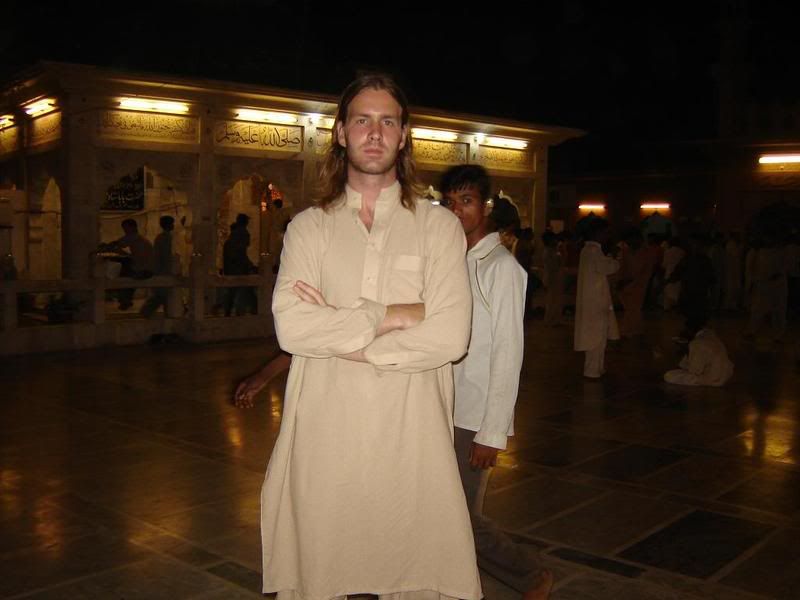
At about 10pm I hopped on the back of Mohammed’s motorcycle and we tore through the streets of Lahore to the shrine of Baba Shah Jamal. We were visiting a Sufi shrine where Sufi’s congregate every Thursday night to worship and meditate. After driving down a crowded dirt side street we parked the motorcycle along with 100s of others and walked up the stairs to the Sufi Shrine. Fruit vendors and elderly Sufis surrounded the area creating a very atypical atmosphere. Shirtless old Sufi men sat on flat wooden tables sporting aggressive beards and colorful bracelets around their biceps, while lethargically smoking hash and conversing amongst themselves.

Halfway up the steps to the Baba Shah Jamal shrine Mohammed and I took off our shoes before proceeding to the top entrance. The Shrine was similar in design to a Mosque, but contained a more complex, progressive and brotherly environment.

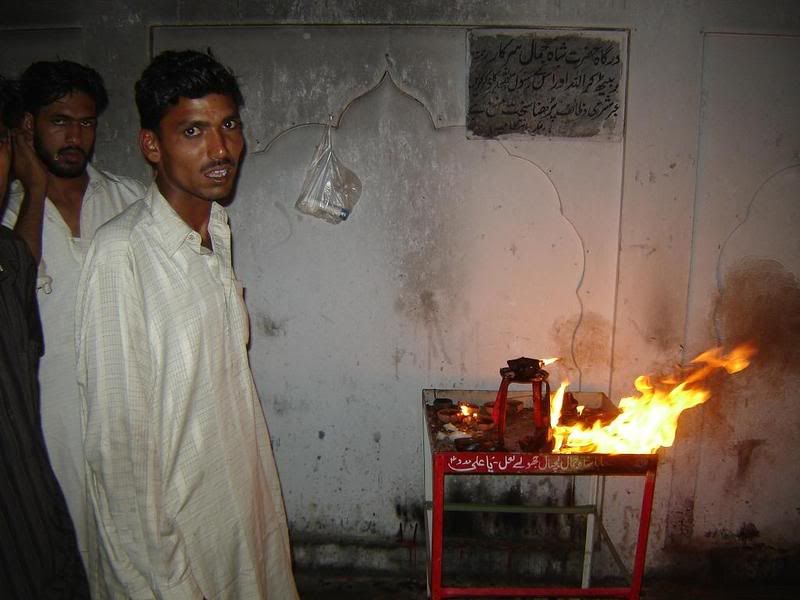
There was on open courtyard with a covered sitting area on one side, and a small room containing the shrine of Baba Shah Jamal on the other. Before entering into the shrine, Mohammed and I dipped our finger in hot oil and touched it against our foreheads ( Mohammed told me to follow his lead). Next we entered the shrine; a small room containing a large ornate casket in the center, and flower petals all over the floor and casket. As we slowly walked counterclockwise around the room we both stopped briefly to bow to the coffin and place our foreheads on the edge of the decorative rectangle box before proceeding forward in line. On the other side of the room was the exit door where each person must turn toward the shrine and walk out of the room backwards (it is considered disrespectful to turn your back on Baba Shah Jamal). Throughout the courtyard, young Sufis walked around socializing and sharing candy, cookies, and pilov(rice dish) with one another. It was quite interesting to see everyone treat each other like brothers and to share the things they had brought. I being the lone foreigner was constantly confronted by curious young Sufis and asked several questions. They all seemed to be amazed by how tall I was; what can I say, we Canadians are tall people.

{Sufi’s have been around since the beginning of Islam; Sufi means ‘free thinker’. So as you can imagine many progressive sects and unorthodox practices within the Islamic faith fall into this category. For example: the whirling dervishes of Konya, Turkey are Sufi’s. Sufi’s are the evangelicals of Islam, which in essence means that a great number of Muslims find their antics to be far too unconventional to be acceptable. Sufis believe that they must meditate deeply (sometimes drug induced) in order to reach an out of this world plane where Allah can be more easily communicated with. Sufi’s are often associated with deep trance drum circles, hash, opium, and explorative meditation.}

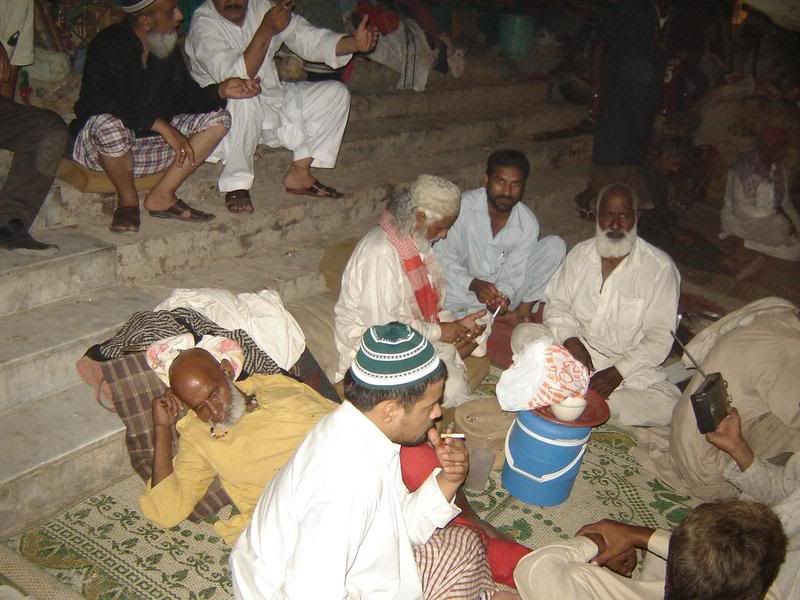
At the edge of the courtyard, I noticed a group of 10-12 elder Sufis with long white beards sitting shoulder to shoulder under a small covered area. I sat in fascination and bewilderment as I watched these men interact with the young Sufis. It was nothing I had ever seen before, and something I found both bizarre and intriguing.

As the old Sufi men sat with their backs against the wall- young mostly un-bearded men began forming lines in front of them. As each young Sufi approached an elder, he would begin by kissing his hand, bowing, and then sitting cross legged in front of the elder Sufi. Next, the Elder Sufi would place his hand on the young mans left knee and begin staring deep into his eyes. They would stare into each others eyes with deep concentration and unrivalled determination. I later found out that Sufis believe that they can transfer spiritual knowledge this way. The Elder Sufis were performing a ritual that allows the younger Sufis to gain a greater level of spiritual knowledge through a two way meditative state.

After a few minutes of staring at one another, the elder Sufi would begin gently tapping the young Sufi on the heart while chanting “Allah, Allah, Allah” over and over again while maintaining deep eye contact. Sufi’s believe that because of constant and inevitable sin, our hearts slowly blacken, and by this ritual your heart can be cleansed. After several minutes of chanting and heart tapping it is believed that your heart will be purified, and that as you sleep your heart will be chanting “Allah, Allah, Allah” with each beat. The young Sufi’s were really getting into it, they would yell Allah uncontrollably while shaking and twitching, seemingly overcome with spirituality. I had no idea that this sort of thing existed within the Islamic world, I suppose each major religion has its own progressive and unorthodox counterpart.

Witnessing this was absolutely incredible; watching this ritual being done by 10+ Sufis simultaneously was a fascinating spectacle. As much as I wanted to document this event with film, I knew it would have been highly inappropriate and disrespectful to the Sufis. I am just thankful that the surrounding Sufis tolerated my presence and allowed me to observe this sacred ritual.

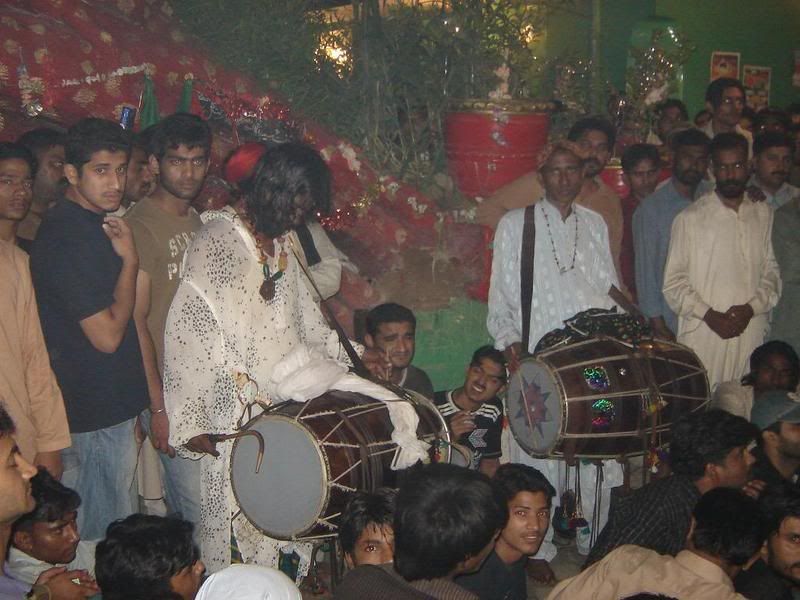
Mohammed and I later left the shrine and headed to a crowded area to the right of the Baba Shah Jamal shrine. Even though the place seemed quite ordinary and common, everyone in attendance took off their shoes to show respect. On the edge of the crowd were two hippie looking Sufis pounding large drums to a hypnotic beat. The crowd consisted of a ragtag group of mostly young Sufis sitting on the cement floor smoking hash and conversing amongst themselves. It was quite a different atmosphere than at the shrine, these people were plunging into a drug induced meditation, while the people at the Shrine were using deep thought and ancient rituals to achieve the same sort of enlightenment. Mohammed found the hash circle to be irritating, and almost immediately wanted to leave. He told me that the people were not real Muslims, but simply drug users out for a good time. I personally found the drum/hash circle to be quite interesting and unique. If I had it my way I would have stayed longer. I found out later that one of the drummers was completely deaf.

At around midnight Mohammed and I hopped onto his motorcycle and began our trip home. We ran a few errands on the way back, buying some flat bread and a bag of milk in a back alley marketplace. Riding through the busy streets of Lahore on the back of a small motorcycle was both exciting and frightening. It was thrilling to see such diverse sides of Lahore; it was quite refreshing in contrast to my predominantly cultureless days spent in Islamabad.

I really enjoyed my evening spent with Mohammed, but could not get past the way he treated me. He often reminded me to hide my nationality, and even forced me to wear my hair down instead of the cooler (temperature) and more comfortable pony tail. Mohammed was constantly nervous around me, and repeatedly reminded me that extremists in the area were on the lookout for Americans. I hated the fact that I could not display myself as an enlightened American, and help persuade Pakistanis that America is not synonymous with evil and hate. While spending the evening with Mohammed no fewer than 10 people asked me where I was from……………and each time Mohammed stepped in and told everyone that I was Canadian. I had enough………one night with Mohammed would be all I could bare. I would much rather spend my days alone and in relative danger than in a cloud of uncomfortable internal shame.

That evening Mohammed and I slept on the couches in the living room, his parents slept on the open air cots on the back patio, his sisters slept on cots in the kitchen, and his eldest sister slept in the small room with her husband and infant child. It was a cozy, crowded and incredibly hot house. Lahore was not surprisingly even hotter than Islamabad………..the temperature was becoming a bit ridiculous and difficult to endure.

5-23-2008

Mohammed left for work before I woke up, and at around 9am his sisters burst in the living room with my breakfast. One of Mohammed’s sisters spoke perfect English and was quite personable and enjoyable to talk to. We spent the morning pleasantly conversing before I decided to hit the road.

At around noon I took a rickshaw to a cheap hotel near Lahore’s large bazaar district. My stomach was acting up a bit, so I decided to spend the day resting and going on short walks around the bazaar. The heat was overwhelmingly strong and pretty much took all the joy out of being outside. The dust, pollution, and 100f+ heat made walking around arduous and increasingly difficult to enjoy.

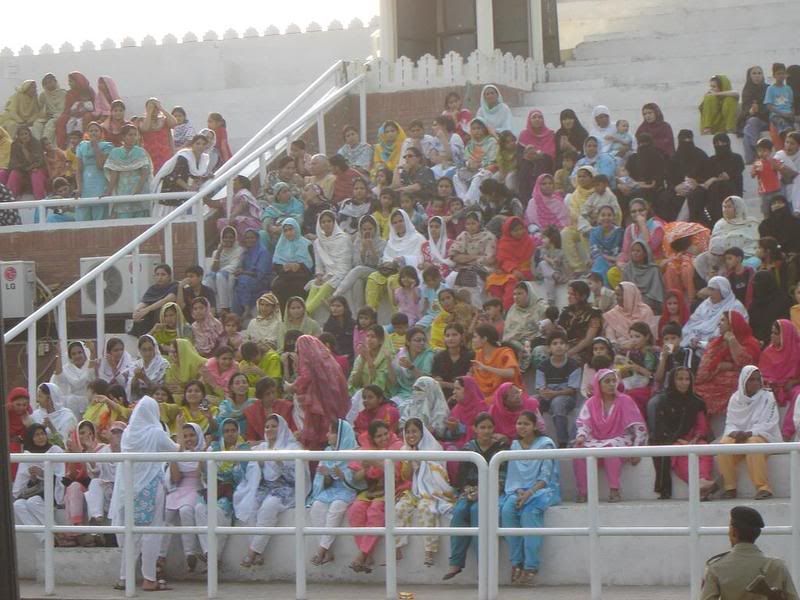
At around 4:45pm I boarded a public bus heading to the Pakistan-Indian border. Each evening when the sun goes down a border closing ceremony begins. After arriving at the border, I bought a ticket and proceeded to the bleachers near the edge of the border. At 6:00pm the closing ceremony began. The entire ceremony was incredibly amusing. Their were two large sets of concrete bleachers separated by gender ( everything is segregated in Pakistan, public busses are cut in half by an iron gate, women in front, men in back), with one small front row section for the foreigners (me). The exact same set up was visible on the other side of the gate, except the Indian side did not appear to be segregated.

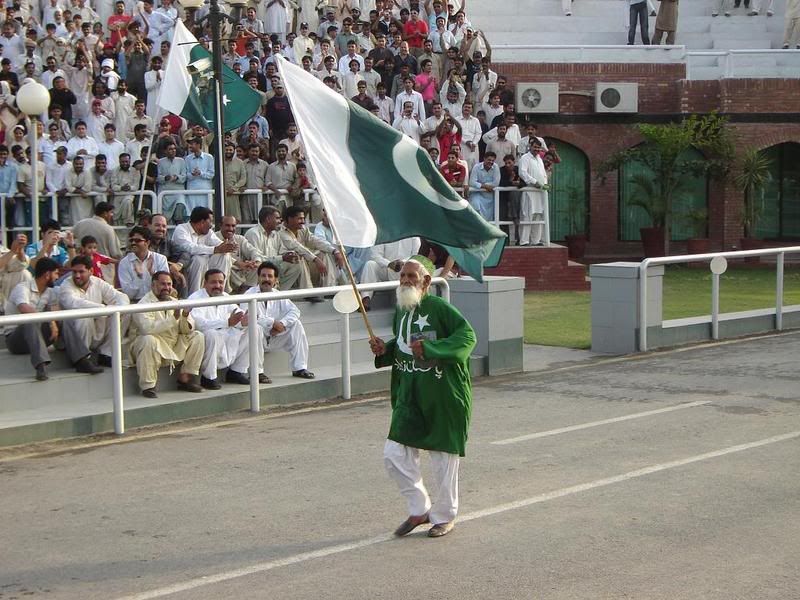
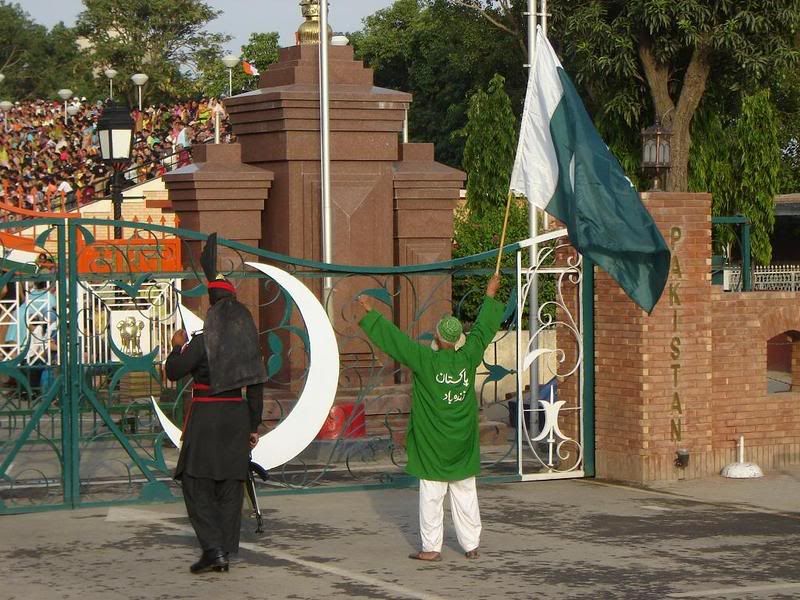
At 6:00pm an old guy with a bushy white beard, green skull cap, green shalwar and a large Pakistani flag began running around the border riling up the crowd. He would run around section to section starting patriotic chants and waving his flag – every so often he would face the gate, wave his flag, and yell things at the Indian crowd on the other side of the fence. The whole scene was wonderfully entertaining; it was like being at a high school football game. Both sides had way too much “school spirit”. Loud music began to blare louder and louder, as men danced around on the bleachers waving flags and yelling patriotic rants. The crowds on each side of the gate would yell back and forth………Hindustan!........Pakistan!...........Hindustan!........Pakistan! The war of patriotic spirit was on!

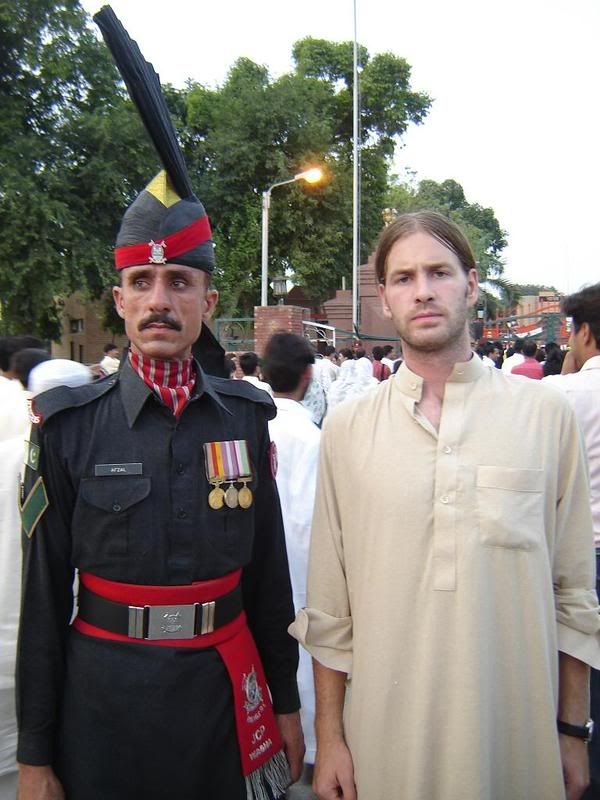
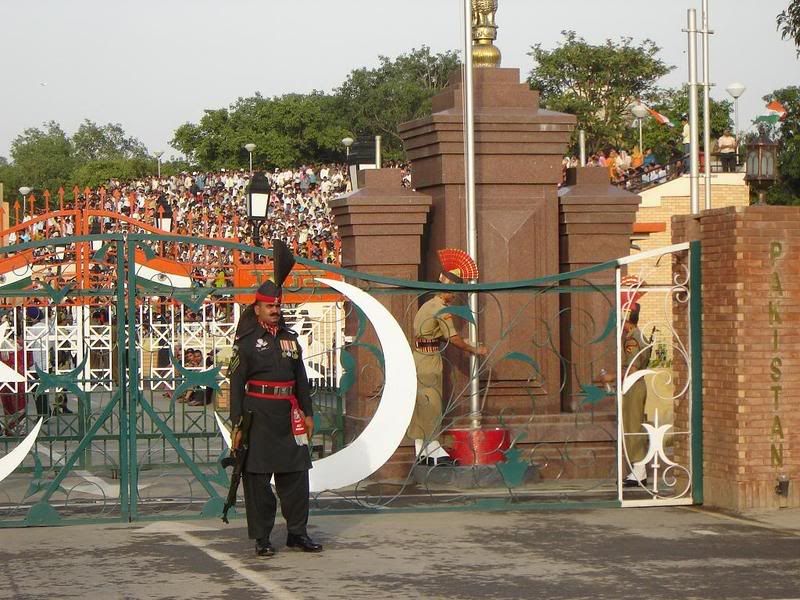
After the flag wielding cheerleaders pumped up the crowds on each side of the border, the soldiers on each side came out and began marching around with firm determination and amplified authority. The soldiers then marched straight legged by lifting their legs high in front of them and pacing forward at a manic pace. Next, the soldiers marched around raising their right leg high and then stomping the ground with excess force. Everything about this formal routine was quite unique and fascinating. Even the military uniforms were unusual; their hats were topped with what looked like Chinese fans.

After some intense military marching and a lot of foot stomping, the gates opened up. Two soldiers, one from each side began some sort of central stomp-off /marching showdown that ended in an aggressive face to face stare down. They then shook hands, did their stomp/march back to their respective sides of the border, while two other men took the flags down and shut the border-gate for the evening.

To sum it all up, the border ceremony consisted of a lot of overzealous patriotism, an Indian-Pakistani handshake followed by the closing of the gates, and the systematic lowering of the flags (done by both sides in unison). It was quite the spectacle, and truly an entertaining event to witness.

While standing on the dusty, crowded bus heading back to Lahore, a man besides me suddenly stood up and adamantly insisted that I take his seat. Within 10 minutes of my departure from the border, I had become a renowned celebrity on the bus. People constantly asked me questions and bragged about their relatives who were living in the USA. At each stop, vendors would briefly board the bus selling fruit, popsicles, tea, etc…………..and each time I would end up with something handed to me. By the time I had reached Lahore; I had been given three boxes of juice, a disgusting flower tasting popsicle, and half a coconut. I have really enjoyed how open, warm, generous, and kind Pakistanis are. I don’t think many Americans realize just how abundantly hospitable and warm Islamic culture is.

That evening I decided to go on a long walk around Lahore while subsequently tracking down dinner and an internet café. Surprisingly less than two miles into my walk I came across a Subway……….not the underground transit system but the wonderful American sandwich restaurant. I was thrilled and did not hesitate to spend four times the price of my hotel room on a delicious meatball sandwich. It was quite the treat…………..three years without a glorious meatball sandwich from Subway was far too long.

After another hour + of walking, I came across a smoky internet café with barely functioning computers. I have found that the internet is my lifeline………..no matter how good, bad, crazy, scary, painful, happy, sad, depressing, or enlightening my day has been, I can always find someone on the internet to share it with. I can send emails, post BLOGs, upload pictures, or simply read American media publications via the internet. Internet is the bright glowing sun in my cloudy days, and thanks to the technological boom of the 90s is accessible pretty much anywhere with phone lines. Life on the road would be infinitely more challenging if I were unable to Google logistical information, Email friends and Family, network with potential hosts, etc. In conclusion the internet has kept me sane, and has been a bit of a crutch for me throughout my Peace Corps experience and my travel experience thereafter.

After I had left my cyber chamber of comfort behind and reentered reality; I realized that while I was in the internet Café, Lahore had flooded. I had never seen roads fill up so quickly with water. There was literally 6-8 inches of water covering the ground, I was now on the banks of a shallow river………..and 4 miles from my hotel. About an hour of unsuccessful solicitation later, I was able to flag down a motor-rickshaw for a ride back to my hotel.

5-24-2008

After thinking hard about Jim Doe’s advice, and his grave warnings about Karachi, I decided to use my own skewed judgment and travel to Karachi anyway. After personal analysis, it became a calculated risk I was willing to take.

At 2pm I boarded a 3rd class train, destination Karachi, Pakistan. Karachi is the large, population 10 million + Wild West city of Pakistan; here goes nothing!

The train ride was to say the least painful, awkward, and uncomfortable from the moment I boarded. The worn out green vinyl bench seats provided little comfort as the radiant heat penetrated through my already overheating body. The ceiling fan provided a laughable amount of comfort while the open windows did little else than enable mass amounts of sand and dust to pour into the train. Heat and dust plugged up the inside of the train to a suffocating level. As the hours passed by, my dreams of cool fresh air became a mockery to practicality, and an unwarranted ambition to comfort.

Slowly the train putted along the rural desert landscape of Southern Pakistan. From the train I witnessed poor Pakistanis working in treacherous heat along the railroad tracks, often napping in the shade. The train cut across desert villages, and tent cities in the middle of seemingly uninhabitable climate. I found myself utterly amazed by how these people could live and work in such conditions. How many Arizona residents would be able to survive without their AC? These people live in tents, without fans or AC, and are forced to work long hours of manual labor with virtually zero shade. It is just one of the many things that need to be put into perspective; perhaps wealthy people in our world should be a bit more grateful for what they already have, and realize that in retrospect, their comfort level leaves little justification for complaints.

The people sitting around the train seemed kind and friendly, but the language barrier prohibited any shared dialogue between us. They would occasionally share with me snacks they were eating, and I would accept by simply smiling and bowing with my hand over my heart. Throughout the long journey passengers and vendors would come on and off the train. Most of the passengers greeted me with smiles; however a few of the men gave me cold intimidating stares. It was obvious to me that these people were not accustomed to seeing foreigners on their train. Every so often a group of guys would approach me and begin speaking with me in simple English. It all became a bit cliché…………I would be berated about Bush questions, dodge all the bullets I could, explain to them how much I loved Islamic Culture, then they would buy me tea……..and later we would shake hands in friendship before they walked away. Thankfully most of the guys on the train did not grill me too hard; I can only imagine how uncomfortable it would be to be confronted with overpowering hostility in a location that was for the most part inescapable.

The day was wearing on me……………the heat was unrelenting, I was sweating buckets, and the dust began coating me like a powdered donut. My skin was about 10 shades darker because it was now caked with a thin film of mud; which I inadvertently smeared around my face while attempting to squeegee the sweat off my forehead. Every so often I would escape the madness and discomfort by climbing to the 3rd level bench seat and attempting to sleep. I had my MP3 player which provided a pleasant distraction, but the dust and heat countered any sort of comfort with intrusive levels of discomfort.

5-25-2008

At 1:30am I suddenly awoke to a loud man made cat sound; I opened my eyes to see two men in their mid 20s inches away from my face. They were staring at me and smiling with probing eyes. Before I knew what was going on they had both jumped up to the upper bench seat I was laying on. The guys began hurling questions at me with intrigue, while smiling like jackals. It was a really weird situation, I was exhausted, uncomfortable, sweaty, filthy, and talking to a couple guys that were way too excited to be talking to a foreigner. For some reason I decided to tell these guys that I was an Atheist………. I for some reason thought it would end questioning, and perhaps be easier than explaining to them I was Agnostic. I was wrong…………….it provoked a 45 minute debate about how it is crazy not to believe in god/Allah, and that I must learn more about Allah. Two hours, 100 questions, and 3 cups of tea later the guys smiled, shook my hand, and exited the train. At around 4am I was again able to attempt a bit of shut eye.

I woke up at 7am feeling absolutely disgusting. It was like being ‘camping dirty’ but multiplied by ten. I was lying in a pool of sweat; my exposed skin was caked with semi-dry dirt, and my face was smeared with thick blotches of mud. The worst part about waking up exhausted and on a hot dusty train, is knowing that you have another 12 hours of misery ahead of you before you reach your destination. I asked myself again……….why do I put myself in these situations? Why did I not just pay an extra hundred bucks and fly to Karachi? After spending months on the road being as frugal as possible, it is amazing how much hardship you are willing to endure to save a couple bucks.

I arrived in Karachi at 6:30pm………..after spending 28.5 miserable hours on the sweltering, dusty, train. My mind and body were numb by the time I had arrived in Karachi. I had eaten next to nothing on the train because when my core body temperature is overheating, I tend to associate nausea with food consumption. The train ride had absorbed all of my energy and left me in a very lifeless physical and mental state.

As I prepared for my arrival in Karachi I decided to hide my camera deep into my bag, and mentally prepared myself for any possible confrontations. I had decided that perhaps telling people that I was from the USA, would not be a wise move in this area. It would unfortunately be prudent for me to take on another nationality while under these circumstances.

Here goes nothing……………..Things were chaotic as I exited the train and began walking across the platform toward the main exit. The platform was jam packed with a colorful assortment of beggars, vendors, and commuters. After exiting the train station I spotted a public bus down the road and without thinking twice, I approached and boarded the old crowded public bus. Upon entering the bus, I Immediately found myself surrounded with cold suspicious stares; it was unlike anything I had experienced thus far in Pakistan. These people really seamed to dislike me and disapprove of my presence…………..my heart began to pound faster, and my legs began to subtly tremble with uncontrollable nerves. One guy in particular was standing about three feet from me sporting a brown shalwar kameez, a long black bushy beard, a white skull cap, and dusty black sandals. He was in his late 20s and was staring at me with piercing, hateful eyes. It became clear to me instantly that this guy did not want me to feel welcome on his bus. I tried desperately to avoid eye contact with the man, but found myself instinctively turning back to glance at him in order to see if he was still glaring at me. Worst case scenarios began to race through my mind like a dark twisted slide show. I began to grow increasingly uneasy about the situation, and decided I would get off at the next stop. Just before I inevitably succumbed to panic and broke down mentally and physically with fear; I felt a gentle tap on my upper back. As I turned around an old man stood up from his chair and adamantly insisted that I take his place. He smiled at me warmly as I sat down in his seat before turning away slowly to gaze out the dusty bus window. It was amazing how something like this could happen…………..here I was literally about to have a panic attack, and all of a sudden I am confronted with a warm, simple, selfless act of kindness that consequently calmed my nerves and eased my mind.

I had no idea where the bus I was on was heading, but figured I would just get off when I saw something that looked interesting. About 15 minutes into the ride, the bus stopped alongside a recent vehicle accident. A public passenger bus similar to the one I was riding had flipped on its side. The shell of the bus was violently mangled, and the partially shattered windows contained highly visible patches of smeared blood. As I began to analyze the scene in more depth, I noticed that several of the people standing besides the bus were seriously bleeding and standing in 2-3ft wide puddles of vibrant colored blood. It was like a scene out of a movie, I don’t know that I have ever seen so much blood all in one place. After stopping at the accident for a couple minutes’, two men from the accident boarded the bus; one man in his late 60s had a deep laceration on his forehead and a broken nose, while another man in his early 30s had blood all over his shalwar, but no visible injuries.

I was incredibly exhausted, filthy, and sweating profusely as I exited the bus, but the fear and adrenaline provided me with enough juice to keep moving. I ended up at the Clifton Seaside……….a long stretch of seaside with an enormous park and a few luxury hotels.

While walking along the crowded sidewalks of the Clifton Seaside, I noticed how exceedingly different the atmosphere had become. There were palm readers and Sufis everywhere. Long haired Sufis sat in circles banging on large drums and smoking hash. Thousands of Pakistanis peacefully picnicked at a large, well maintained seaside park. All in all the area seamed relatively progressive and safe. I kinda expected people to be running through the streets with machine guns while hurling grenades at each other. It appears that I got lucky, and ended up in a calm perhaps even safe part of town.

It was now about 7:30pm and I was beginning to run out of daylight, I thought it would be prudent to lock down accommodation before things got too late. I ended up just walking around until I got lost and wound up in some sort of primitive bazaar area.
Narrow dirt roads, ground littered with animal bones and rotten vegetables, rotting piles of trash everywhere, pools of fresh animal blood, tailors, butchers, various vendors, and swarms of flies pretty much sums up the area. I have never in my life seen so many flies; shop keepers fanned flies away with square pieces of card board, but as soon as they stopped swinging the cardboard, the flies would cover every inch of the meat and fruit they were trying to protect. It was a bizarre and disgusting thing to witness.

The deeper I walked into the bazaar the more uneasy I began to feel. Darkness and cold stares began to penetrate and suffocate my strength. Instead of smiles and hot cups of tea, I was served frosty stares and unwelcoming smirks. This was definitely a neighborhood I should have avoided; I was clearly not welcome here. I began hearing bickering and whispers behind me, which invoked an uncontrollable sense of panic that sent a shockwave down my spine. Was I being followed? Had I got myself into a potentially fatal situation? What the hell was I thinking going into this neighborhood?...............I began to walk faster and faster as sweat poured heavily down my face. I had no Idea where I was and had no idea how to get out of this crazy maze of a neighborhood. The footsteps seamed to be getting closer and closer, even as my pace began to increase. Before I knew it I was at the edge of the neighborhood and near a main road; fortunately I was able to make my way out in one piece. With open air came pleasant relief and gradually subsiding paranoia. I was again in a relatively open area and began to feel a thin blanket of security upon my shoulders.

Darkness fell, and severe exhaustion and panic compelled me to immediately hop into a rickshaw and leave the area. I told the driver to take me to a hotel, and about 20 minutes later we had arrived in an area with no less than 15 hotels. We were actually back where I had started, near the train station. Finally my day was at an end! I could now find a hotel, take a shower and get some much needed rest. The last two days had been hell, and I was now more than ready to shut down my engine for a while.

Panic, exhaustion, frustration, and anger began to consume my body as each hotel I approached refused me occupancy. Over and over I was told that it was too high of a security risk for them to host me. After visiting no less than 20 hotels and miserably walking four miles through the loud, chaotic, and frightening streets of Karachi; I found a hotel that would take me. It was 11pm.

The hotel was incredible! After seeing the flashy new sign, and the four guards armed with AK47s out front; I new this place was a winner. The guy at the front desk spoke perfect English and told me he would allow me to stay at the hotel for $50; we settled on $20. I had enough danger, exhaustion, and excitement for one day. All I wanted to do was to get some food and go to sleep. I perhaps should add that the entire time I was on the train I had “stomach problems”…………..my stomach had been in shambles since arriving in Lahore. Since leaving Lahore the previous day, I had consumed only 4 juice boxes, 2 mangos, and 5 cups of tea. Thankfully now that I was at my final destination and in a safe secure hotel, my stomach was relaxed enough to welcome solid foods. For some reason, when I am severely stressed out and anxious, I tend to completely lose my appetite.

After checking into my room I ordered some fried chicken from the Pakistani style KFC across the street, but decided to play it safe and eat the meal in my pleasantly secure hotel room.

5-26-2008

I slept like a baby and woke up feeling great, the electricity stayed on the entire night, and the temperature remained cool and comfortable throughout the night. After eating a delicious continental breakfast; I took a taxi to the airport and by12:30pm was on a flight to Kathmandu, Nepal.

From the moment I left Lahore to the moment I left Karachi for Kathmandu;……….I felt severe discomfort and endured endless amounts of self inflicted pain. I really had no justifiable reason for this sort of traveling. It is not fun, enjoyable, enlightening etc……. It is simply a marathon of pain, fear, discomfort, agony, uncertainty, and stupidity. In hindsight everything about the last couple days falls into the reckless and foolish category. I can always say that I made it through Karachi in one piece, but at what cost? Was my less than 24hr experience in Karachi worth the potential dangers? I suppose nothing really went according to plan; I was told that the train ride would take 17hrs………..not 28.5hrs. This was a quite unpleasant surprise. If I had a bit more time in the city, perhaps I would not have jumped on the first bus I saw, or wandered through a poor unwelcoming neighborhood. I arrived in Karachi with less than 2 hours of daylight, exhausted, scared, and pumped full of adrenaline. I left Karachi rested but marginally exhausted with an overwhelming sense of foolishness.

{I made it out of Karachi alive but in hindsight, the decision to visit Karachi was quite reckless. Pakistan is now considered by many people to be the most dangerous country in the world. In the last year(2008): Newsweek, The Economist, and Time Magazine have published articles stating that Pakistan is the most dangerous country in the world. Karachi is said to have the highest street crime rate of any city in the world.
-Between January 1st, 2008 and August 31st 2008, there have been 149 kidnappings for ransom in Karachi. Over 1,000 murders take place each year in Karachi, and it has been said that 100 rapes occur each day in Karachi. So I guess…………Pakistan, and Karachi specifically was not the safest destination of my journey.}

-So this is pretty much the end of the road for a while. My trip concluded with Nepal, India, Thailand, Cambodia, and South Korea…….but I am not sure I will write about those experiences……..I really appreciate any writing feedback………so if you have anything to say good or bad……..please leave a comment or send me an email. I am planning on rewriting a lot of my stuff, and perhaps will turn it into a book. Thanks for reading………knowing that people read this nonsense gives me inspiration to write.
Trevor Lake
laketrev@hotmail.com

Here are a few pics-
Sufi shrine in Lahore:
Photobucket
Photobucket
Photobucket
Photobucket
Border ceremony:
Photobucket
Photobucket
Photobucket
Photobucket
Photobucket
Mohammed and his family:
Photobucket

Friday, October 10, 2008

Peshawar, Pakistan

5-15-2008


I left Chitral at 8:40am on a crowded, cramped, and horribly uncomfortable mini-bus heading to Peshawar. I experienced faint hesitation and was a bit nervous about visiting Peshawar because of its close proximity to Afghanistan and the notoriously dangerous tribal areas between Peshawar and the Afghan border (Wazirestan). During my logistical research, I read that Peshawar had become a hot bed for terrorists, and that it was becoming increasingly unstable. Apparently terrorists were flooding into the tribal areas from Afghanistan and threatening the stability of Peshawar and Pakistan in general.


The paved road ended at about 11:40am as the bus began its ascent up a beautiful mountain pass. Besides the continuously painful discomfort and the rapidly transitioning  scenery, the next few hours were rather uneventful. At around 2:30pm we stopped in the desolate mountain town of Dirat for lunch. Upon arrival in Dirat I was immediately befriended by a Pakistani businessman from Peshawar on his way to Chitral. He spoke perfect English and thankfully was more than happy to help me order some food from a nearby restaurant. I am constantly taken back by how friendly Pakistani people are. Even in my shalwar kameez I stick out like a sore thumb; which in essence helps attract friendly locals who seem to feel compelled to invite me into their daily lives with warm smiles and gentle curiosity. Dirat was a very bleak mountain town with friendly locals and weakening dry heat. Due to the high elevation and mountainous landscape, the northern regions of Pakistan are much cooler than the central and southern regions. As the bus inched its way toward Peshawar the temperature steadily rose, and my personal discomfort continued to climb to near unbearable levels. I numbed the pain periodically by nestling a pinch of naswar against my gums; the anesthetizing nicotine coursed threw my veins quickly, and partnered up with the music of Matt Costa to bring on a chemically, and melodiously induced trance of inspiration and reflective thought. 


When we stopped for dinner at 7:00pm, I observed several subtle aspects of change. Along with the landscape becoming monotonously brown, flat, and dry; the people seemed marginally more introverted and less welcoming to infidels. I was now entering the heart of Pakistan, far away from the generally safe and delicately isolated northern regions. 


At 8:45pm the bus pulled into a noisy, crowded, loud, and obnoxiously dusty dirt lot on the edge of Peshawar. I had no idea where I was and was a bit nervous and intimidated by my predicament. Peshawar was huge and incredibly underdeveloped; I was out of my element and beginning to feel a bit unsure about my immediate personal safety.………To top it off; I had no Idea where I was going. From previous travel experiences I have learned that a city’s bus station is generally a haven for con artists and sketchy individuals. As a result of this gained knowledge, my first objective was to immediately flee the bus station and then to reevaluate the situation in a safer location. As I walked along the dark, deafening, and agonizingly dusty street; I was stalked by overzealous rickshaw drivers and inquisitive vendors. I was a bit like a fish out of water and constantly on my guard. Despite my traditional Pakistani attire, the large backpack I was carrying over my shoulders overpoweringly screamed tourist. I really had no idea exactly how safe the area was, or if I was even heading in the correct direction; consuming fear and overpowering adrenaline kept me moving along the dark road at a frantic pace. Even so late in the evening, the heat was almost unbearable. Walking five+ miles with a 40lb pack in 95F+ heat was not easy; I was sweating buckets and was horribly fatigued by the time I reached a central area with a few hotels.


My fear and frustration elevated dramatically after being refused accommodation by the first five hotels I visited; each time the owner of the hotel would politely explain that their security was not adequate enough to host me. What does that mean? Were they worried about my safety, or were they simply trying to avoid hosting an infidel? I guess a bomb going off at their hotel would not be good for business. I eventually found an adequate/cheap hotel at around 11pm. I was sweating profusely, exhausted, filthy, scared, paranoid, hungry, and more than ready for a bit of a breather. The hotel was definitely on the trashy side; it was a dusty, windowless, dimly lit, concrete building with cracked walls and high ceilings.


My room: 8x8ft cement box, small bed with torn, stained and collapsed mattress, small filthy bathroom with a squat toilet and rusty shower pipe(no nozzle),no sink, no windows, and one barely operational ceiling fan. 


My room was like a cement sauna; thanks to the lack of ventilation, the fan’s only productive effect was to push hot air back into my face. This was by far the trashiest hotel I had ever slept in. But for $1.30 a night……….how was I to complain. The problem with this place as well as the rest of Pakistan for that matter is that the power supply is both sporadic and unpredictable. I was in my room no longer than 20 minutes before the power shut off and I became encased in awkward, frightening, and painful discomfort. My black coffin of a room was turning into a bread oven. The lack of ventilation was suffocating me, it literally must have been around 130F in the room when the fan was off………..it was horrible. I felt my way through the darkness into the bathroom, the small dark room that held the key to my survival. I devised a solution to escape the inevitably looming effects of heat exhaustion. The solution………..20 min in the shower, 40 minutes sprawled out naked on the bed. It worked, however the radiant heat dried me in minutes and left me sweating profusely for the last 30 minutes of each hour. At 2am the power kicked back in and the heavenly fan began to spin around like angel wings. It was a lifesaver; I was not sure I would be able to handle the intense discomfort much longer. In reality, who was I kidding, where else was I to go. After another quick shower, I laid in my bed/hammock and finally was able to get a bit of shut eye. At 5am I woke up in a pool of sweat, my deep innie belly button turned into a sweat filled shot glass that poured down my sides with excess each time my lungs filled with air. Back to the misery and pain! I hopped in the shower again and resumed my cooling strategy for about an hour before giving up on sleep entirely in order to begin my day. At 6am I escaped my concrete coffin and began wandering down the adjacent street away from my hotel. Down the street a ways, I came across a crew of construction workers sitting on a dirty side walk eating a vegetable and rice salad. The guy’s operation appeared to be relatively sanitary, so with little hesitation I purchased a serving from the street vendor for 25cents and consumed it with slight anticipation of future nausea. It was early in the day, so I perceived that the plate I was using was only used a few times before me that morning……………it could have been much worse. The sun was shining and the food was delicious; I suddenly became increasingly excited about exploring Peshawar. 


After wandering around in circles for a few hours, I came across a small internet café in the basement of a run down block apartment. The computers were ancient and the connection speed was ridiculously slow, but it did the trick. I was eager to research my future travel logistics and to contact my host in Islamabad.


At around 11am I took a rickshaw to Peshawar’s bustling old bazaar area and began my exploration. I was still marginally intimidated and fearful about Peshawar’s reputation, but eager and intrigued by my surroundings nonetheless. I was in Peshawar, the city on the edge of Pakistan’s disreputable tribal areas, and about to explore a world famous bazaar. The bazaar was incredible; it was amazing to be in the middle of something so chaotic, yet serene. The bazaar was endlessly abundant with just about any sort of consumable you can imagine. I thoroughly enjoyed this bazaar mostly because of the people; instead of being hassled and heckled, I was constantly greeted with copious arrays of enchanting warmth radiating from brotherly smiles.  I was no longer afraid of Peshawar; my suspicion, hesitation, fear, and bewilderment rapidly melted away with each pleasant interaction.


Within two hours of arriving at the old bazaar; I had been befriended by a dozen people and been treated to four cups of tea. It was surprisingly difficult to walk down an entire block without being coerced into a hospitable gesture. The loud, crowded, dusty streets, were no longer a place of fear and overwhelming intimidation, they had become a place of warmth, a quiet village nestled away within rolling hills of fragrant flowers. The mask was taken off and what I saw within was something beautiful. 


After about four hours of wandering, observing, and casual interaction; I became completely lost. I was not sure exactly where I was, but knew that I was definitely far from the old bazaar. I ended up in a large courtyard containing green grass, an old mosque, and several bushy trees that gave off an abundance of well appreciated shade. While sitting on a crusty cement bench in the courtyard I was approached by on old man sporting a bright white shalwar Kameez, a bushy white beard, and a white skull cap. His face was dark and leathery, with deep creases around his eyes and across his forehead. He greeted me with a warm smile and a “ asalam ahalikum”. I responded with “ halikum salam”. The old man soon began talking about his son who lived in Sacramento and how much he loved America. He then passionately explained to me that Muslims are generally good people, and how he does not understand why ‘Bush’ wants to destroy his religion. I was not exactly sure how to respond to this accusation; I have been approached with similar statements and accusations on several occasions, but am taken back each time the subject is broached. The man intensely proclaimed that the US invasion of Iraq was simply an action taken with intention to destroy a Muslim nation and to spread democracy and Christianity. He was adamant in his statements and had no doubt in his mind that the USA’s government wants nothing more than to eradicate the religion of Islam. I decided to just sit back and listen to this man vent, I was unsure how to respond to the man, and was not sure if confrontation and debate would be productive.


Well, another strange and awkward conversation in a very volatile region……………what is the appropriate response? I suppose over the last few months my answers have become more and more polished, and my opinions have become more dynamic. My rebuttal was a bit typical:


 “There are over 300 million Americans in the USA, and most of them do not believe in the fundamentals of our current presidency. Our country is made up of a beautiful mixture of displaced immigrants from all parts of the world. We have complete religious freedom, and by law must respect all of the many religions of our nation. There will always be bad and good people in each and every country of our world, unfortunately the western media puts it’s emphasis on the bad, and shines light on hatred, ugliness, and bigotry rather than love, respect, acceptance, and tolerance. I assure you that America does not have any intention to eradicate Islam, nor does it want to take over Islamic republics. America was attacked by a group of Islamic radicals full of hatred, and it spooked our presidency into making poor decisions with miscalculated consequences”


After discussing, and peacefully debating for about an hour, we shook hands and parted our separate ways. I enjoy these sorts of interactions immensely; each time I am able to speak to a person with a view different than my own, I feel enlightened and am able to look critically at future situations with a broader point of view.


Within 30 minutes of leaving the courtyard I ended up in a bustling back alley filled with goats and textile shops. Even though the street was slightly shaded, the walls of the narrow alley radiated vast amounts of powerful heat that expelled sweat from my body like an unripe steak. Despite it being only 2:30 in the afternoon, my body was already shattered with fatigue. 


A young guy with a long beard spotted me from across the street and waved me over. He was sporting a military style (camouflage) hat and an off-white shalwar kameez. As I walked across the road to greet him he flashed me a warm smile and said “hello please sit down”. While sitting down beside him, he observed my sweaty, worn out appearance with concern and told me that I should sit and rest. He then walked into the building and came back shortly with a Coca Cola on the rocks. It was just what the doctor ordered; it was the most delicious and revitalizing coke I had ever consumed. My new friend’s name was Ahmed and he worked as an assistant/security guard for the small medical clinic. Moments later another man named Mohammed came from within the medical clinic to greet me; he had dark skin and soft eyes. After finishing my coke Ahmed escorted me into the clinic and sat me down in a small office at the end of the narrow hallway. The office was dimly lit, had a large ceiling fan, and was decorated with cliché, flagrantly bright posters of farm houses, domestic animals, and sports cars. I sat in confusion, alone in the office for about 15 minutes before the director burst into the room to greet me.  She (Johar) sat down across from me and with a suspicious/confused/curious look asked me what I wanted. The question caught me off guard……………..what did I want? I was escorted in off the streets and now was sitting in the director’s office of a hospital. I told the director that I was a tourist and that I had been casually invited to the clinic by Ahmed for a short rest and a cold drink. She internally analyzed my answer briefly before asking me if she could get me something to drink. After politely declining her offer, she gave me a strange look before ordering her assistant to bring me a Coke. The director of the hospital was a plump, pretty, and confident woman in her mid 20s. She had just finished medical school and was now overseeing her parents (both physicians) clinic. We spent the next hour discussing various correlations and contrasts between our countries’ health care, education system, and social dynamics. 


I found it fascinating that she was so cold, cynical and stubbornly pessimistic when it came to love. I consider myself a bit of a cynic when it comes to “soul mates”, “true love”, “destiny”, “marriage”…….etc. but she truly blew me away. She believes that love is childish and non-existent in the mature educated world. Her views on marriage were very business oriented, very structured, with little room for nonsense. Johar believes that your parents always know what is best for you, so when the time comes they will choose the perfect mate for you. And this arranged marriage is not about love, it is about “your duty”……which pretty much means your put on earth to work hard, make babies, train your kids to live a lifestyle free from sin and corruption,………then you die. I find her opinions interesting and practical………….but I am not sure I am ready to throw out self interest, spontaneity, deviance, and romantic love in favor of a dull, scripted, monotonous, conservative, and highly orthodox life.


After our little chat, Johar told me that I must come back at 1:40pm for lunch. After thanking her for the hospitality and conversation, I stepped out into the rugged heat and continued my journey to nowhere. In order to ensure I did not become disoriented, I simply walked in a straight line down the hot dusty street away from the clinic. I figured as long as I did not make any turns I would be able to retrace my steps and return to the medical clinic with ease. I now felt very comfortable in Peshawar; I had been confronted only with smiles and kind words. Where were all the terrorists at? Where were the cold stares, harsh words, and blind hatred? Was I in the same Peshawar that I had been reading about on the news?


Peshawar’s dry heat was debilitating, and agonizingly uncomfortable. It was well above 100F as I walked down the crowded streets dodging decorative buses and aggressive rickshaw drivers. After walking about two miles in unbearable heat I decided to take a bit of a breather. I found a corner store and picked up a small bottle of cold ‘Arabian Dew’ (tastes just like Mountain dew, Pakistanis love their Mountain dew!) and a small brick of Naswar ( chewing tobacco). I spent the next 30 minutes sitting on a dusty, shaded curb sipping soda and enjoying the effects of strong Pakistani tobacco. My body was stoned and my mind was numb as I sat on the curb, sweat pouring down my face, trying in vain to unravel the complex thoughts and perplexities plaguing my conscience. 


I have found that I enjoy putting myself in awkward and uncomfortable situations. I thrive on stepping outside of my comfort zone and into unfamiliar territory. I suppose it is the way it makes me feel that drives me into these situations. The feelings of vulnerability, confusion, fear, excitement, danger, shame, and enlightenment spike when I am outside of my element. I am beginning to believe that this adrenaline rush caused by disposition and fear is perhaps borderline unhealthy. Is that why I am in Pakistan? The need to push the envelope, and constantly take things to the next level has landed me in an increasingly unstable country, with undeniable dangers and volatility. The interesting thing about my off the path travel experiences is that I have continually come to the same conclusions: No place is as dangerous as you may initially think; ignorance breeds fear. People are the same all over the world; love, hate, lust, greed, kindness, selfishness, playfulness, happiness, sadness, desire and determination, are things possessed by all human beings no matter what your race, ethnicity, religion or geographic location may be. Love, warmth, kindness, open-mindedness, and tolerance opens doors to friendship, and dissolves ignorance and hatred.


At 1:40pm I arrived at the medical clinic and was greeted warmly by Ahmed and Mohammed, who were both sitting in white chairs near the entrance of the clinic. Ahmed then escorted me to a back room with a fan, dining table, and a dozen rusty chairs. The electricity was off, which made the room turn into a sweat box. I was forced to constantly wipe the sweat off my forehead in order to prevent the dust and sweat from invading my already burning eyes.  I  then sat alone in the dimly lit room for 40 minutes……………..Had they forgot about me? What was I doing? Should I head for the door and sneak out of this relatively awkward situation? I decided to tuff it out, and eventually my lunch arrived. Ahmed presented me with chicken, yogurt, hot milk, coke, and a tomato-cucumber salad. After eating my lunch in silence and isolation; four middle aged Pakistani men entered the room. They all sported long bushy beards and light colored shalwar kameezes. I stood and greeted the men as they entered the room with confident demeanor and curious eyes. We then sat around the table and began to discuss my favorite topic………..American politics.


To say the least the conversation was a bit rough around the edges. It was a four on one political debate where the gloves were off and the river of propaganda was raging uncontrollably. After calmly debating with the men about the Iraq war, President Bush, Pakistan-USA relations, and Islamic extremism;…………the men touched a nerve that sent me into a uncontrollable whirlwind of rage. After listening to one of the men go off on a tangent about how the 9-11 attacks were planned and allowed by the US government, I completely lost my composure. 


-The man’s argument: “The USA has seamless intelligence, intelligence so broad and thorough that it would be impossible for the USA to allow such a large scale attack to slip through its fingers unintentionally. The USA condoned and helped plan the 9-11 attacks because it wanted an excuse to attack and conquer Islamic nations. The USA’s goal is to eradicate the religion of Islam, control all of the world’s oil, and convert all people to Christianity. The 9-11 attacks were not executed by Islamic extremists; they were simply a series of accidents caused by mechanical problems within each airplane.”


The last statement is what tripped my breaker switch and took me over the edge. I stood up, walked up to the guy and said:


“That is the most ridiculous thing I have ever heard in my life. There is bullshit propaganda everywhere, and just because it is written on a website, or in a newspaper does not make it true. Here are a few facts for you: Islamic extremism is very real. There are in fact Muslims who hate my country enough to perform a Jihad attack on it. The 9-11 attacks were executed by Alqeida! There is no gray area, there is no room for debate……………it happened. Islamic extremists killed over 3,000 people in my country in one day. It is not a conspiracy! The USA would not bomb our own country, or allow terrorists to kill thousands of people just to create an excuse to start a war. These statements are common sense. America is a country of diversity; we are all displaced immigrants (with exception to American Indians) trying to make better lives for ourselves in a very young country. My country is not perfect, neither is my government. We are not one culture trying to extinguish another; we are many cultures and ethnicities trying to live as one in a land of growing tolerance and acceptance. Our intelligence is very complex and strong, but not free from error. It is literally impossible to avoid all terrorist activity through intelligence. The fact is that Americans do not generally like President Bush! We do not believe his decisions in relation to Iraq were good ones. I did not choose to invade Iraq………..my president did this on his own behalf, and under false pretenses. I believe going into Iraq was a mistake, and so do most Americans. You must understand that there are over 300 million Americans in the USA………..and the majority of them despise President Bush and his Middle Eastern foreign policy. I find it absurd that you would believe all the stupid, bullshit propaganda you have been told. Why would any country shoot themselves in the foot? Not everything is grey……………………this issue is black and white.”


I literally yelled this statement as loud as I could, and with furious anger. My throat completely dried out and created a painful and uncomfortable tickle in my throat. Even after pounding a glass of water, it took me a full 10 minutes to get my voice back. 


After regaining my composure, I looked around the room and was a bit taken back by how silent the men were. They were all in shock and seemed to be a bit embarrassed about setting me off like that. I guess they adequately comprehended that they had offended me, and now understand just how sensitive Americans are when discussing the 9-11 attacks. 


One man stood up and broke the silence by saying: “we are all brothers and were simply born in different geographic locations. We know and understand that there are many things said about the USA that are not true; but we do know that your president is no different than Hitler. He is a bad man, and is responsible for the deaths of many Muslims.” 


We all stood up, smiled, shook hands and left the table without animosity, hatred or anger. We understood each other; we knew that we could not possibly see eye to eye on all of the complex issues of recent international politics. We are simply concerned citizens of or respective nations, who are concerned about the future of our countries.


After our debate, three of the men left, while Ahmed and Johar reentered the room to present me with the idea of going to a museum. I told them I would love to go to the museum, but first had to purchase some clothes from the bazaar. 


I walked about a mile from the medical clinic to a small tailoring shop on the edge of a small, goat infested alley. The shop owner did not speak any English, but sent off his assistant to track down someone who did. A few moment later three teenagers entered the shop and greeted me with energy and enthusiasm. Within 30 minutes the teens had helped me buy 8 yards of cotton cloth from the bazaar, and explained to the tailor that I wanted a shalwar kameez made with the material. Everything went off without a hitch; I was measured up and ready to pick up my tailored clothes the following morning. 


When business was finished, the three guys took me next door to their shop for an orange Fanta and a bit of conversation. The three young guys berated me with questions that I was more than happy to answer. Throughout my time on the road, I have been asked just about everything, and have come up with polished answers to even the most controversial questions. Toward the end of our conversation one guy asked me……….. “What advice can you give us?”……………….. …………………………………………………………………………………………………….. I thought about it for a minute and then proceeded to say:………………………….   .……………………………………………………………………………………………. “My advice to you is to leave your country for a short time so that you will be able to analyze your country from the outside in. It is important to see that there are multiple sides to every story, and often it is difficult to understand the world within the comfort of your own country-city-neighborhood. If you have spent your entire life exclusively drinking Coca Cola, and have seen only Coca Cola commercials and advertising; how can you possibly know anything about Fanta? There is nothing wrong with you choosing to solely drink Coca Cola, but it will provide you with a more accurate personal comparison and contrast if you know first hand exactly what Fanta tastes like. So basically what I am saying is: step outside the comfort of your everyday life, and go see the world.”


His response: 

“You do not understand, you have no idea how we live, what you say is not possible for me or any of us. You think that we can simply leave our country and explore the world, but you have no idea what you are talking about, because you know nothing about our lives. I am 16 and must support my parents and my sisters; exactly how can I afford to leave me country? We live in a poor country, and have responsibilities to our families; we are not free to leave. You just don’t understand that what you say is not possible for us.”


Well what can I say, the kid had a point. Who am I to tell people the road to enlightenment is to see the world, and that anyone can do it. I grew up in a financially stable family, in a wealthy country full of opportunity. What do I know about the life challenges of Pakistani teens? I suppose it is a bit challenging to follow your dreams when you are held down with enormous amounts of responsibility, particularly with your family’s financial wellbeing. I suppose my advice becomes void and foolish when speaking to those of less privileged backgrounds…………I will never forget this conversation because it brought me down from the hippie cloud I was floating on and pulled me back to earth. Life is not fair, suffering is inevitable, and most people live and die without chasing after their dreams; dreams and aspirations often die at a young age. Unfortunately,…….. responsibility, maturity, and rational thought can be the kryptonite for lofty dreams and personal aspirations. 


After my humbling and slightly disheartening conversation with the young guys, I headed back to the medical clinic to meet up with Ahmed and Johar.


 About 30 minutes after I had returned to the medical clinic, a new guy named Zar showed up with a small ornately modified car and moments later we were off to the museum. Before I left Ahmed gave me his army hat and shook my hand with a warm smile.


Zar, Johar and I drove to the museum at around 7pm. The museum was closed for the evening but was quickly reopened after a bit of bakshish (Arabic word for tip money) was presented to the guards. The museum was quite interesting; it consisted primarily of ancient Buddhist artifacts found throughout Pakistan. I could see the cultural and national pride in the eyes of my hosts as they paraded me around the museum. It had been a long day, and I was pretty much exhausted by the time I had reached the museum, so I can’t say truthfully that I enjoyed the museum much.


Later that evening Zar drove Johar and I to a four star hotel called Pearl Continental Hotel. It was by far the nicest hotel in Peshawar. The hotel was absurdly priced and outrageously extravagant, however this did not stop my hosts from parading around the joint like they owned the place. It was an interesting situation, I found myself over evaluating the situation; this is my curse, I tend to over evaluate everything………Why was I taken to the nicest restaurant in Peshawar? Is there something they expect from me, or are they simply trying to display their wealth to me? Am I expected to pay for the food? Would they have taken one of their Pakistani friends here, or was I here simply because I am a white guy from the USA. Was this simple dinner and short lived façade of wealth going to disrupt their financial stability? After all, a $100 dinner bill to your average Pakistani correlates evenly with a middle class American spending $1,000 on a meal. Sure it can be done, but it is not something that should be taken lightly. The dinner was dragged out for three long agonizing hours………I was tired, bored, and generally was not into the conversation. It turns out that Johar really wants to further her education in the USA, but is not sure exactly how to get her foot in the door. I told her I would be her sponsor if she applied for a visa and perhaps help her look around for potential scholarships, but generally there is not much I can do to help. After I had finished out the conversation, consumed a bit of chicken, 3 cups of coffee, and some chocolate cake, we were on our way home. I was dropped off at my hotel at 10:30pm…………it was a long day and I was exhausted.


When I arrived at my hotel the power was completely out, the guy at the front desk had to escort me to my room with a flashlight. I was blind as a bat in my pitch black room and again sweating profusely. It was horribly uncomfortable……………your body can handle about 20 minutes of 120F+ heat before your head starts feeling funny, and the nausea begins to creep up on you. At this point I feel my way toward the bathroom and have a seat on the 3 in wooden platform below my shower. I sit on the platform mainly to avoid the 3 inch cockroaches that squirm around my bathroom floor when the lights are out. (They really freak me out…………..they are literally the size of small mice.) After turning on the water I simple lean forward, hug my knees and sit in strange, but soothing silence for about 30 minutes. The water crashes against my back, and eventually cools the core of my body to a degree that the nausea subsides and I again feel brave enough to reenter my dark furnace of a room. Again I am lying wet, naked and in comfortable darkness pondering recent events and experiences.


-Why did I get so worked up about the whole 9-11 conspiracy comment? Why did I feel comfortable confronting the guy and yelling at him? Was that a potentially dangerous move? Why the hell did I spend 3 hours in a posh hotel restaurant today? Would it have been worth it to splurge on a $20 room in a nice hotel? $1.30 for a room is not bad………but is the pain and discomfort worth the money I am saving?


The electricity kicked in around 1am…………and I drifted off to sleep shortly after. I awoke at 4am sweating buckets and feeling nauseous…………..time for a shower.


I checked out of the hotel at 7am…………….gave a confirmation phone call to my host in Islamabad, picked up my tailored shalwar kameez, and within two hours was on the 11am bus headed to Islamabad.


Medical Clinic crew

Photobucket

The guys who helped me in the bazaar

Photobucket

Photobucket

Photobucket

Photobucket


Friday, August 29, 2008

-The Hindu Kush-


-The Hindu Kush-


5-11-2008


My body was slowly falling apart and I feared for the worse as the bus pulled out of Gilgit at 7:30am; my head was pounding and my stomach was aching for food, but the thought of consuming anything other than soft fruit overwhelmed me with intense feelings of nausea. In this condition, how was I to survive a 15+ hour hot, cramped, and bumpy bus ride? I have been shedding pounds at a frightening rate throughout my journey; I currently weigh about 180lbs, a full 35lbs less than I weighed 3 years ago before I left the USA for my Peace Corps assignment. The major issue being that I was relatively skinny when I left; which means now I am simply unhealthy.


 Food poisoning, sporadic eating habits, and overall malnutrition are excellent ways to lose weight and help bring out your inner skeleton. I should create a weight loss program when I return home; food poisoning is the perfect way to unite bulimia and anorexia together in order to create the perfect combo of rapid weight loss without the psychological issues that accompany both. One rotten sandwich a month for 6 months………and I guarantee you will shed those pounds, but always be anxiously waiting for the diet to end!


The bus driver skillfully drove along the sketchy partially washed out road, dodging large boulders, gushing streams, and half cleared landslides. The road cut along the canyon wall with incredibly sharp precision that left very little room for error. We were never far from a fatal accident as we constantly had to slam on the breaks to avoid head on collisions with oncoming cars. I kept my sanity by putting the situation into perspective; this man does not want to die, nor does he want to kill everyone on the bus, and he obviously knows the road and its limitations to a much greater extent than I. Still, looking down 300ft cliffs that are only inches from the edge of the bus is frightening. The road was a maximum of only a lane and a half wide in most segments, and was only partially paved. 


While driving along the windy road, I began seeing inspirational words written with white spray paint along the stony cliffs. The words were written in both English and Urdu and were usually 1-3km apart. The messages read: “Serve Nation”, “Educate Your Children”, “Develop Your Area”, and “Help the Tourists”. I interpreted these messages as a sign of forward progression for Pakistan. The people of Pakistan do not want to fall into the fiery pit of self destruction and intolerable extremism. They appear to be striving toward being a fundamentally religious but progressive nation; a nation free from epidemics of war, hate, pain, ignorance, and political turmoil; a nation that strives to pull away from the very things that have been crippling their Islamic counterparts.


At 11:50am our bus peeled off the road and stopped for lunch at a small mud/wood shack alongside a shallow river. I was a bit confused about the eating situation, but thankfully was taken under the wing of the man I was sitting next to on the bus. I followed him into the shack where we left our shoes at the door, and proceeded to sit on the floor surrounding a straw matt; soon after, we were all served vegetable curry, rice, chapatti, and milk tea. I felt a bit strange, awkward, and out of place; however, moments like these are what I truly thrive on and strangely enjoy. The inquisitive man next to me spoke broken English and looked about as fair skinned as any European I had ever met. He had light brown hair, a thick colonial mustache, and green eyes. The only part of his appearance that made him appear ethnically different was his Chitrali cap and his shalwar kameez.


I definitely was the oddball of the crew; most of the men around me had long thick beards and sported Chitrali caps with their shalwar kameez (traditional clothes). The men in the shack stared at me intimately and seemed to be discussing me intensively as we ate. I had no choice but to smile occasionally when eye contact was made, and recognize that I was simply a weird looking guy, wearing weird clothes, and in a land where reverence and cultural conformity is incredibly important. If I were dining at a restaurant in the USA, and a Kenyan Bushman walked through the door (wearing traditional clothing) and sat beside me at the table, I would most likely inadvertently analyze the man and discuss his lack of conformity. From day one I have been completely aware that I am merely a guest in the countries I visit, and it is my responsibility to respect each land’s culture, religion, and social norms despite how radically they may differ from my own. 


 After lunch we all boarded the bus and were soon on our way. A couple men on the bus had spent their break fishing down beside the river; one of the men was now holding three small trout gilled by a thin twig. I thoroughly enjoyed the company of the man next to me; we discussed a variety of topics but did not dive too heavily into anything much deeper than small talk. It was pleasant to discuss simple things like family, work, and recreation; as opposed to international politics and President Bush.


I was only able to choke down about half of my lunch, which instead of curing my hunger and soothing my aching stomach, actually made me feel worse. I found it increasingly difficult to enjoy my surroundings and to take pleasure in the moment. I was traveling an unknown road, a road of vast cultural significance and natural beauty, but unfortunately was not in the proper condition to soak in the atmosphere and properly enjoy it. 


We constantly picked up villagers and dropped them off as the bus slowly made its way along the increasingly shabby road. I noticed that several of the village women we picked up had dyed orange decorations on their hands and wrists, their children had the same markings. The dye on their hands is similar if not identical to henna ink, and is called “mandee” in Urdu. Some women had it decoratively painted on their hands, while others had their entire hands sloppily dyed orange. All of the village women wore traditional burkas (decorative long baggy shirt, and pants) and covered their hair with colorful shawls. The Pakistani women would often cover their faces with their shawls and turn away the moment they caught a glimpse of me. I guess that is what I get for being an infidel.


One of the steep rural towns (Golokmuri) appeared to be having some sort of festival, perhaps it was a wedding. The whole village seamed to be celebrating together on a grassy hill resembling a natural amphitheatre. Further down the road was the town of Gurdu, where villagers stocked the bus inquisitively as it drove through. The villagers of Gurdu wore shabby, tattered clothes and overall looked quite filthy. Despite the villagers’ rugged appearance, their smiles radiated strongly enough to exhibit an outline of happiness and contentment with their rural mountain village lifestyles. When the bus stopped in Gurdu, a woman boarded the bus holding a small child with her face painted like a batman character. Speckles of a black tar like substance was caked around both eyes, cheeks, and her forehead like a lone ranger mask; after later inquiries I found out that this was considered to be healthy for the baby, because the black substance attracts the sun and keeps the baby warm. We were in fact high on a rugged mountain pass, where the air was considerably cooler than the lower valleys.


The scantily paved road officially turned to dirt and rocks at 2:30pm, which resulted in the slowing of our already sloth like pace. We were now traveling less than 15mph along the steep bumpy road up a rocky mountain pass. I witnessed several large families having picnics amongst their livestock on the grassy rolling hills that surrounded the road.  Throughout the mountain passes we would drive in the vicinity of small villages where the children would spot me and enthusiastically run along the bus in order to catch a glimpse of the strange looking foreigner. Many of the children wore green baseball caps with “Pakistan” and a white star printed on the front. When the bus occasionally stopped, I noticed that the villagers greeted each other by first the woman kissing the man’s hand and second the man kissing the woman’s hand. I poked my camera out the window and took a couple of photos of the kids surrounding the bus, a few of the young girls seemed repulsed, scared, and furious, while others smiled and eagerly crowded toward my window. Their faces were dirty; their clothes near deterioration, and a surprising number were cross eyed (which often suggest incestuous behavior…….)


The rural mountain villages along the isolated dirt road consisted of clusters of mud shacks alongside lush green fields of grazing yaks.  The people that gathered around the bus at each stop looked weathered, worn down, and had dry chapped hands. Despite their physical appearance, they did exhibit an exuberance of happiness. Each person returning to their village was greeted with ecstatic reactions and an abundance of smiles. Many of these villages were far from electricity, and generally seemed to be self sustained.


The village at the top of the pass was called Shandur and consisted of little more than a polo field and a tea shack. Apparently Shandur hosts several important polo games each year. Leading up to Shandur was a series of steep grassy marshes filled with grazing yaks. A couple of times we dropped off shepherds equipped with camping gear at desolate fields tens of miles from the nearest village. Shandur was surrounded by rolling hills of lush green grass and lined with massive snow capped mountains. The Yaks grazing near the road would lift their bushy tails and athletically sprint away from the road as the bus slowly crept up the hill. I was actually quite surprised to see how agile and athletic the yaks were. They would raise their tails and sprint around the fields like hyper gazelles; quite impressive for such a large beast.


After a quick tea break in Shandur we began our descent into the desolate and seemingly inaccessible Lasper Valley. The road began to get sketchier and sketchier as we made our way down a frightening series of cut backs. Several times the bus driver had to send his assistant outside in front of the bus in order to guide us along the narrow road. We were literally a 7inch landslide away from disaster and death. The 300ft cliffs on the edge of the road made my heart race with fear. This was by far the most dangerous road I had ever been on. The road was cut into an unstable mountainside of falling rock, and was barely wide enough to hold a vehicle. The collapsing sections of the road produced the frightful appearance of a serrated knife.


I breathed a sigh of relief when we reached the village of Mustouch, home of the 5th and final police check point before Chitral. Each time there was a police check point; I was forced off the bus to fill out a form (Visa #, Passport #, destination, etc.) and answer a few simple questions. Most of the police I encountered along the way were friendly and gave me little hassle.


It was now 7:00pm and we had traveled only 262 kilometers from Gilgit. Which means the bus was traveling at an average speed of around 15 miles per hour. 


After the police check point the bus continued for another 20 minutes before stopping indefinitely. Apparently this was the end of the road, but we were still 114km from Chitral. The road was too windy, rough, and narrow to handle a small bus; from Mustouch onward the roads were only accessible by jeep. 


I was absolutely exhausted by this point and I felt as if I had a stomach full of jagged rocks. My options were to either stay in Mustouch for the night and catch a jeep to Chitral in the morning, or to simply keep the party going and continue my journey. I decided to go with the latter; I was horribly fatigued, but wanted to get it all out of the way in order to wake up fresh and rested in Chitral.


I was not actually hungry, but my painfully empty stomach yearned for substance; so I decided to try and track down a bite to eat. After a quick exploration of the desolate mountain village, I came across an old wooden shack selling groceries and shoes. There were very few consumables in the place besides peanuts and stale cookies;….I opted for the dusty box of milk I scoped out on the floor near the worn down combat boots. Boxed milk never really goes bad does it? The 8oz box of milk was covered with dirt and was a bit rough around the edges, but I had irrational confidence that it was legit, so I made the purchase. After pounding the box of fermented dairy poison I was off to find a ride to Chitral.


I easily tracked down a man with an extra seat in his old beat up land cruiser and hopped aboard. We left Mustouch at around 7:30pm, at which point I soon discovered that the jeep trail to Chitral was pretty much insane. We drove along the thin barely visible jeep trail, over the top of landslides, through deep streams, and around recently fallen boulders that obstructed our path. The ride was bumpy, terrifying, and slow going, however we were definitely making progress.


9:05pm- we stopped in ParWak, a desolate village consisting of a small makeshift gas station and a few mud shacks. I actually felt quite uneasy about this stop; my mind began racing wildly as worst case scenarios were uncontrollably bouncing around in my skull. Why were we stopping? Perhaps so they could take me into a shack and decapitate me after lecturing me about my “anti-Islamic American Government”. Of course my mentality at this moment was paranoid, ridiculous, and skewed, but in the back of my mind I was fully aware that stranger things had happened.


Should I have felt comfortable with the situation? Is it unnatural for an American to feel a bit uneasy while alone in the darkness of desolate North West Pakistan? I followed the four other men from the jeep up a hill and into a small mud shack with no door. As we entered, the room suddenly became deathly silent. What I visualized upon entering the shack was a mirror image of what the Western media had pounded into my mind. Here was a room full of dirty, bearded, terrorists, with horrible extremist intentions and hearts as cold as ice. Why was I unable to see a room full of kind, gentle, friendly men, conversing about the same sort of life issues we all do while congregating around friends at our local American dive bars? I later felt horrible, guilty, and disgusted about my racist, ignorant, and unfairly presumptuous first impressions.


 The dimly lit room was filled with middle aged Pakistani men with dirty clothes and shaggy dark beards. They were all sitting on a foot high wooden platform covered by a dirty Persian rug, smoking hash cigarettes and quietly conversing amongst themselves. At the end of the platform was a prehistoric television set tuned into what looked like the Indian version of Baywatch. Even though the reception made the picture almost unwatchable, several of the men stared at the television with undivided attention. As I stood in silence observing my new surroundings, I could not help but contemplate the possibility that I was in a room of uneducated militants with very strong opinions about the Bush administration. 


After about five minutes of suspicious stares, and verbal inquiries directed at my driver, the men lost interest and went back to their Bollywood Baywatch. At the end of the shack was a small mud stove where they were cooking vegetable curry and rice. As I slowly approached the stove an old hunch-backed man stood up off his 6 inch stool and with a weathered smile, graciously offered me his seat. Moments later I was handed a plate of food and a cup of milk tea. The men cordially smiled as they intently observed me consume my gift. 


My stomach was in poor form as I desperately tried to choke down each bite of the dry, barely consumable rice and vegetable curry. I felt awkward and rude not being able to finish my meal, so I discretely ditched my plate of food and snuck out the backdoor into the darkness. I awkwardly hid outside in the bushes near the jeep until my jeep-mates were ready to hit the road again. We were back on the road at 9:30pm, tearing through the moonlit trail with frighteningly aggressive tactics. 


The next leg of the jeep trail was periodically obstructed by large herds of sheep. I am still unsure whether the shepherds were beginning or ending their day. Why where shepherds herding sheep at 11:30pm? Was it possible that they where working the shepherd graveyard shift? Is there a shepherd graveyard shift? Anyways, my driver became increasingly frustrated by the obstructive flowing rivers of sheep, and constantly yelled out his window at them. Judging by the intensity of his tone and body language, I believe that my driver was threatening the shepherds with some form of violence for obstructing the road.


At about 11:45pm the dirt road finally ended and a paved road began; within a half hour we had arrived at the largest city in the Hindu Kush, Chitral. 


The streets of Chitral were quiet, empty, and dimly lit by street lamps. I was dropped off in the center of town, and within 30 minutes was able to find a cheap hotel room to lay my head ($4). The room had peeling green wallpaper, one small cot, a rock hard pillow, and raggedy off-white sheets. The 8x10 windowless room was blazing hot and had one of the most disgusting toilets I had ever seen. It was now 12:30PM………and despite the condition of my hotel room, I felt relaxed, peaceful and ready to sleep. After a cold shower to cool down, I hopped into bed and almost immediately fell asleep. 


At 2:30am I woke up suddenly after having a horrible nightmare that I was drowning in a pool of dark sludge. When I woke up I was desperately gasping for air and was choking on a mouth full of vomit. Stomach juices disgustingly sprayed across my chest, legs, and bed as I stood up frantically coughing up the rancid contents of my throat and mouth. My balloon like stomach was bloated and stretched out to the point of bursting. I was scared. The next 6-8 sleepless hours I puked, burped, farted, shat, and laid in my bed painfully deflating. The situation was all very strange, terrifying, and uncomfortable. I was actually afraid to fall asleep because I thought I might die. Perhaps it was a bit silly to think that, but waking up choking on your own vomit is frightening.


5-12-2008


At 11am the young hotel owner suddenly burst into my room and was shocked to see me still lying in bed. I abruptly responded by yelling at him and telling him to get the hell out of my room. I guess that was my wake up call. After a cold shower, I consumed a handful of salty cookies, pounded a quart of iodine flavored water, and was on my way out the door. The streets of Chitral were now bustling, loud, and packed with people. I was in the middle of a large bazaar with shops selling everything from naswar (chewing tobacco) to machine guns. As I wandered through the busy streets of Chitral, I was constantly presented with curious stares intermixed with warm smiles and guiltless curiosity. Eventually I made my way past a cluster of armed soldiers and across a small bridge to the jeep-station on the far end of town. 


Upon arrival, I was quickly befriended by Timuk a 21 year old college student from the Kalasha valley. He had been studying economics and English in Peshawar and was eager to converse with me in English. With pride and enthusiasm he began telling me all about his village of Bumboret and how I should definitely visit the Kalasha Valley. His stories intrigued me and immediately sparked my interest. What was the Kalasha Valley? Why had I never heard of this strange place? Timuk told me to take a jeep to the Kalasha valley and that he would meet me the following day to show me around his village. I accepted his offer without hesitation and immediately boarded a small double-cab pick up truck heading to Bumboret.


{The Kalasha valley consists of three small villages tucked away deep in the folds of the Hindu Kush. The total population of the three villages (Bumboret, Rumber and Birir) is around 3,500 people. The Kalasha valley is extraordinarily unique because of its one of a kind language, religion, and culture that has been incredibly maintained throughout its history.}


I was astonished by how many people we could fit in the pickup truck. Five other people and I sat facing each other on bench seats in the bed of the truck, 6 people occupied the seats inside the truck, and 6 other people stood on the bumper hanging off the back. It was quite impressive that this truck was able to take such abuse; we were like a bunch of monkeys clinging to a safari jeep.


The Hindu Kush was absolutely beautiful. The road between Gilgit and Chitral seamed to be geologically forced within one long jagged mountain valley. However, once we entered Chitral the canyon magnificently open up into a series of deeply cut mountain valleys surrounded by enormous hills and dominant snow capped peaks. The area was lush, green, and justifiably under populated.


 It is hard to believe that a place like this still exists in the world; an area so desolate, inaccessible and implausible that a community as culturally and ethnically diverse as the Kalash has been able to remain intact and avoid the sharp destructive claws of globalization and religious oppression. How were the people of the Kalasha valley able to avoid religious and cultural coercion and persecution throughout their long history? How were they able to avoid urbanization and forced conformity? My only hypothetical answer to this question is that the tremendously isolated location of the Kalasha valley has adequately preserved their culture by forcefully maintaining a unique, simple, desolate, but sustainable lifestyle of the villagers.   


After a long stretch of wavy road that plowed deeply through thick green vegetation high along the mountainside, we began a descent into the small barely accessible town of Ayun (20km from Chitral). Ayun is situated at the base of a valley, between a large river and the sharp, rocky mountainside that breaks slightly making a heavens gate entryway to the Kalasha Valley. Ayun at first glance(my) is a very primitive looking town of dusty dirt roads, shale roofed mud shacks, and skeptical locals. Groups of tired and weathered looking men squatted together in front of the meat markets and curiously observed the passers by. Most men on the streets of Ayun wore dirty shalwar kameezes, Chitrali caps, and large checkered turbans around their necks.


After passing through Ayun we began to climb higher and deeper into the mountainside on an increasingly narrow dirt road. The road followed the rim of a steep canyon on a trail blasted out of solid rock. After about 30 minutes we arrived at a police check point where I was asked to fill out a form, pay a registration fee, and answer a few questions. Apparently it was mandatory that I register with the police station in Chitral before entering the Kalasha Valley. After a bit of confusion on both ends of the conversation, the police decided to let me through as long as I promised to return the following day to Chitral and register.


The rocky dirt road cut gently onward through the narrow canyon to an increasingly desolate location. The road was barely wide enough for a jeep, and often hugged the edge of 100-150ft cliffs. Parts of this road were down right terrifying, but being able to look forward and see just how deep we were into such a marvelous canyon was amazing. I felt as if I were driving into the unknown, a place where no white man had gone before, a true expedition. Of course this was far from the truth, but nonetheless being in such an isolated area and foreseeing cultural discovery and adventure, raised my spirits significantly and enchanted my soul. 


The scenery became more and more beautiful as the canyon began to open up into a lush green valley of fruit trees, grassy fields, grazing goats, and sporadically placed mountain shacks. I had no idea what to expect when entering the Kalasha Valley; I only knew that it would be culturally different, and situated in a very beautiful, lush, secluded mountain valley.


 The first time my eyes gazed upon a Kalash woman I felt indescribable exhilaration. Through the thick plum trees about 30yds away from the road, I saw an old woman standing like an angel near the edge of her garden. She had long, dark, exotically braided hair, with a colorful, beautifully beaded headdress that wrapped around her head like a halo and draped down her back. She wore many bright colored necklaces around her neck and a long black dress edged with thick colorful patterns. Something about that opening visual really moved me. I felt that I had finally seen something pure and different, something so unique that it shattered the MTV-CNN-FOX-CORPORATE- bullshit of my generation, and produced a glimpse of cultural purity that I had never seen before. It was like going on a long hike through a desolate mountainside and suddenly coming across an American Indian wearing a beautiful headdress, and traditional clothing; but this Indian was of a lost tribe, unaware of the pushes and pulls of today, unaware of the unavoidable cultural oppression and dilution of our modern world. Imagine that this Indian was part of a tribe that was located so deep into the forests that it had been completely untouched by the outside world, and able to remain free from the poisons of our modern, corporate, greedy, rapid paced, ugly, urbanized and selfish modern societies. 


I am not so naïve as to think that I had discovered a culture unscathed by modern society, however I am convinced that the Kalasha Valley is one of the few places in the world that has remained culturally pure throughout the years, and I pray that this will not soon change.


After being dropped off at the bottom of Bumboret, I slowly walked up the dusty road soaking in what I could of the magical atmosphere. Each time I saw a local villager, I was taken back by their stunningly decorated attire, and their ability to completely ignore my presence. Children ran up and down the dirt road playing with a short stick and an 8inch wide wire wheel. They would guide the wire wheel upright while moving it along with their stick. The girls would giggle and play together in the grass fields along the narrow stream that zigzagged every so often across the main road. Women were working in the fields and socializing while washing laundry along the river bank. Clothes were scattered amongst flat, bleached white river rocks, radiantly drying in sun. I find it a quite challenging to describe in words just how uniquely Kalash women present themselves. Their clothing and accessories are made out of bright joyful colors; their hair is braided into a very distinctive and exotic style. The hairstyles of the young girls are even more peculiar; they often have a shaved head except for two long braids, one on the front, and one on the back of their heads. The front braid is always tucked behind one of their ears and draped down the side of their kneck. The Kalash men wore regular Shalwar Kameezes and Chitrali caps as they rebuilt parts of the road and looked after sheep along the rocky hillside. The only cultural difference in their clothing was the feather they wore sewn into the front of their Chitrali cap that signified they were Kalash(not Muslim). 


My initial observations of Bumboret exceeded my expectations significantly. I immediately began to realize that this would by far be the most interesting and significant section of my journey. In a way, being in the Kalasha valley gave me a boost of energy and added drive to continue my exploration; but it also presented a peak of greatness and amazement that perhaps I will never again be able to reach.


After a quick observation of my surroundings, I came across a small guest house where I dropped off my bag and decided to check in. There was no electricity or plumbing, but the price was right and it included two meals per day. Despite the excitement and exhilaration I was feeling as a result of my newly found paradise, I was exhausted from lack of sleep, and a bit run down with sickness. After checking in I promptly laid down on my bed and fell asleep. I woke up around 7pm and decided to wander further up the road and explore the area. 


The narrow valley had only one poorly maintained jeep trail that cut through the center of the village. The heart of Bumboret is a large cluster of old wooden houses intertwined like shingles on the steep hillside. The houses in the center of the cluster have thick mud/wood roofs that the locals use to congregate and socialize. Each small house appears to have been put together centuries ago using an age old traditional carpentry technique. The large pieces of dark wood used in the construction of the houses, give the homes a very rustic, primitive charm. 


5-13-2008


I woke up at 5:30am, ate a quick breakfast and was in a jeep heading to Chitral by 6am. At 8am I arrived in Chitral and was immediately befriended by a young Chitrali cab driver named Mohammed. He guided me to the police station where I spent the next hour shuffling from room to room filling out forms and answering questions. After registering my Mohammed and I did a bit of clothes shopping at the local bazaar. I managed to pick up a baby blue shalwar kameez and another Chitrali cap for under $10. I have personally found that it is prudent to stay low profile in Pakistan. Wearing local clothes, and being cautious and discreet while taking photos is a good way to keep from making waves. As an American in Pakistan, the last thing I want to do is stand out. I have found that having long hair, wearing local clothes, and taking very few photographs has helped me maintain a low profile. If I had a shaved head, wore western clothes, and ran around photographing everything; perhaps my experience in Pakistan would not be quite as pure-safe-pleasant.


I quickly made it back to Bumboret and past the police check point without any problems. I was happy to have made it back to the Kalasha Valley in time to view the beginning of Kalasha Valley’s spring festival dubbed Joshi. 


At around 5pm I began walking up the road to the heart of Bumboret. I came across a small green field near a narrow creek where local villagers were practicing their cultural dances. Young boys methodically pounded large drums as the young girls danced together in harmony with interlocked arms. While sitting on a small rock at the edge of the field and observing the dancing; my Kalash friend Timuk slapped me on the back and sat down beside me. He told me that the women were gathering flowers on the mountainside and would be parading down the road soon. Timuk spent the next hour sharing his culture with me by explaining many of the Kalash customs and traditions. 


This is what I learned:


- The Kalash people live only in the 3 villages of the Kalasha valley. 

-Language: the people of the Kalasha Valley speak a unique unwritten language called Kalash.

-Religion: They practice a pagan religion called Kalash. They often sacrifice goats for various reasons to please their god Mohadeo. Most serious religious ceremonies take place at their spiritual house called the Gestikan. The Gestikan is full of animal figures and effigies, and is a place commonly used for birth and death rituals. The Malosh is a holy place near the village where sacrifices are commonly made to Mohadeo. They believe in only one god, but a god with several deities that protect various aspects of life.

-Birth: - A holy ritual is performed at the Gestikan and a goat is sacrificed.

-Death:- if the deceased  age is 10 years or older, all three Kalash villages will congregate and sacrifice 50-70 goats and a few cows. The body is placed in the Gestikan for two days, villagers visit the body during this period in order to pay their respects. The leaders/elders of each village will give speeches about the life and accomplishments of the deceased. The villagers then have a large feast of cheese, bread and joosh (boiled goat), they use up 40-50 bags of flower during the celebration. They also drink their fair share of home made wine and brandy during the funeral ceremonies. Bodies are buried in the village graveyard called the modokjol.

-Women: wear traditional clothes at all times. They produce all their clothing by hand and are all masters of their craft. Small tattoos on the faces of women are a sign of beauty and maturity.

-All women are considered unclean during menstruation (5-6 days a month), and are forced out of their homes to a small female only house called the beshali. The beshali has a yard but there is a line in the yard that they are forbidden to cross until they are “clean”. They are not to be touched by anyone during this period, and are not allowed to converse with other men.

-After childbirth, the Kalash woman must go through a purity ritual, and is sent to the beshali for ten full days.

-Marriage: Kalash villagers usually get married between the ages of 18-22. 

Women are expected to maintain their virginity until marriage; men are not.

People get married only after falling in love, marriages are never prearranged. The man will surprise the woman and her family by randomly kidnapping her, after they elope the families will then meet. The families then have a month to get to know each other and to agree with the marriage and decide the dowry (gift from groom’s parents). After this is settled, they will perform a ritual, and sacrifice a goat to make the marriage official.

Festivals: The Kalash celebrate several festivals, most have to do with the beginning of harvest seasons. Timuk’s favorite festival is Chomus. It takes place December 18-20, and each family must sacrifice a goat for the celebration. The festival is full of dancing, eating, and drinking mass quantities of home made wine. (I imagine this is why Timuk likes it so much).Joshi festival is the festival of spring, and lasts an entire week. The heart of the festival is between May 13th-16th. Each of the three villages hosts one day of the festival with a large dance and celebration.

-Bumboret is the largest of the Kalash villages, and Birir is the smallest(Rumber is obviously somewhere in the middle).


Where on earth did they come from??????

-There are three accepted theories to this question, however they have all remained inconclusive.

1) They are descendants of Alexander the Great’s soldiers, which makes them more or less Macedonian immigrants. This is plausible because Alexander the Great did in fact trample through Northern Pakistan sometime during the 4th century BC. He was also known to have occasionally planted groups of soldiers to start cities  throughout his conquered lands. And of course the Kalash people generally have quite fair skin 

2) They are from Asia, and migrated from the Nuristan area of Afghanistan.

3) The Kalash people migrated to Afghanistan from a place in South-Asia that the Kalash people call Tsiyam. The land of Tsiyam is talked about in Kalash folk songs, and their epic stories.


After a fascinating and very educational conversation with Timuk, we started walking up the road toward the Kalash women. We soon met them on the narrow dirt path and watched them slowly drift by with beauty and grace. The women were singing a very serene mantra as they marched down the hill in unison. While gliding in sync, they clutched each others shoulders with one hand, and carried a bouquet of yellow mountain flowers in the other. I felt privileged to be with my friend Timuk ,because my association with him allowed the Kalash women to feel at ease, and in essence trust me enough to photograph them. Earlier in the day the same Kalash women would shyly turn away when I approached them. Now they were smiling at me and even posing for photographs. Two of  Timuk’s sisters were part of the mini-parade, so being a buddy of Timuk’s really got me in the door. We followed the beautifully dressed women down the hill and to the grass field where everyone danced in unison to the melodic beat of the drums. It felt amazing to be the only tourist experiencing such an incredible event. 


Later in the evening, Timuk and I walked around his village discussing life, love, and the cultural differences of our two countries. We ended up in the home of his aunt, an old wooden house in the center of the giant hillside colony. The house had two small dirt floor rooms and a small covered patio. Only one of the rooms had a door and was furnished with cots to sleep on. The other small room contained a few wooden trunks, a couple small stools and a tiny stove. Timuk’s Aunt’s home was very simple, yet practical. We sat on small wooden stools on the patio and drank home made apricot brandy while snacking on walnuts and dried apricots. Our conversation was very limited due to the massive language barrier, but thankfully, kindness and hospitality can be expressed without spoken words. Timuk’s Aunt generously presented me with a beautiful thin decorative chest-band as a gift for being a guest in her home. I was blown away by her amazing generosity and warmth toward such an outsider like myself.


Next we headed to Timuk’s house where I was greeted cordially by his mother and sisters. The house was quite similar to his aunt’s home, but had one small extra room for socializing. The room was 8x8ft and had a small hole in the ceiling that let in enough sunlight to light the room (neither home had electricity or plumbing). The dark wooden walls were covered with pictures of bollywood actors in revealing clothing. I was invited to sit down on the small straw matt of the “social room” and was immediately presented with walnuts and homemade wine. My new Kalash friend kept cracking the walnuts for me and presenting me with the flesh of the nut. He always treated me as a brother, and displayed kindness and generosity graciously. Not long after sitting down, Timuk and I made a toast and pounded our glasses of wine. He followed the toast by pouring us each a glass of homemade apricot brandy. A few minutes later his mother entered the dimly lit room and presented me with a blue and yellow bracelet as well as a pink and orange chest-band. After the evening winded down, I  gratefully thanked my hosts and made plans to meet Timuk the following morning.


Words cannot describe how incredible I felt as I walked home from the heart of Bumboret. I had spent the evening as a guest in the homes of some of the most hospitable, kind, and unique people I have ever met. Despite feeling relatively ill throughout the day, I feel confident in saying that this was by far the most pleasant and memorable night of my journey thus far. I fell asleep feeling a strange almost spiritual sensation that consumed my mind and body. I was feeling a level of contentment and blissful happiness  that I have not been able to attain since my early childhood. It sounds a bit strange to be affected this way by a simple evening, but in reality this was the zenith of my journey. It was a moment of bliss that made all the food poisoning, bumpy bus rides, horrendously long train rides, frozen midnight walks, cold stares, police shake-downs and repetitive political debates worth it. Traveling long distances, months at a time along unpolished and unreliable paths is ridiculously challenging. But in the end; the experience, knowledge, and insight gained is absolutely priceless. People explore the unbeaten path despite enduring endless amounts of self inflicted hardships simply because “the ends always justify the means”.


5-14-2008


I woke up smiling at 7am and by 8am was on the roof of  Timuk’s aunt’s house drinking milk with the locals. Today was “milk day” of the Joshi festival, so the un-pasteurized goat milk flowed like wine. After hanging for a bit with Timuk‘s relatives, we hopped into an old station wagon and were off to Rumber to enjoy the festivities. The crew consisted of  Timuk, his brother, two of his cousins and his Muslim friend from Islamabad (Ahmed). The vehicle was uncomfortably packed with sweaty guys and live poultry. In the back of the vehicle were three live chickens that flipped out and flew around the car after each bump we hit. The situation was strange, hilarious and uncomfortable, but fairly enjoyable. It felt great to be part of something so unique and unusual. I was thrilled to be in a station wagon with a group of young Kalash men on the way to Rumber’s Joshi celebration. For the first day in close to a week, I felt healthy, rested, and mentally alert. 


At 11:30am we arrived in Rumber. Rumber is located about an hour away from Bumboret by jeep. It is nestled away in an adjacent mountain valley, and is equally as desolately located as Bumboret. The extraordinary thing about the Kalasha Valley is that it is geographically hidden, and is located in a vast paradise of natural beauty. The main residence of the people of Rumber is a cluster of wooden houses located near the base of the valley. The festivals take place on top of a flat surface high on the hillside.


Rumber was glowing with exotic charm, as we drove up the final stretch of the trail.

Beautifully dressed Kalash women lit up the dusty mountainside like Christmas tree ornaments. Their colorful and radiant appearance created an enchanted atmosphere of cultural pride and tradition. Rumber was much smaller than Bumboret, and appeared to be even less financially sound. Kalash villagers are very simple, generally poor people that seam to live a near poverty yet peacefully adequate lifestyle. They don’t have much, but their community is so tightly knit that they tend to take care of one another like a giant family.


 I immediately noticed that the women of Rumber more commonly had facial tattoos than the Kalash women of Bumboret. The light blue facial tattoos of Kalash women were very small and simple: usually a dot or a dot surrounded by a small circle on their forehead, chin, and one on each cheek. Occasionally a woman would have a small V tattooed between her eyebrows.


After arriving in Rumber the entourage and I walked across a small wooden bridge and past a primitive but clever hydro-powered flower mill before arriving at Timuk’s cousin’s place. We greeted our friendly Kalash hosts by saying “Shpata Baba (to a woman)” and “Shpata Bya(to a man); this means hello/greetings in Kalash. The crew and I then sat down on the floor in one of the rooms and were soon presented with homemade apricot brandy. The strong brandy loosened my mind and enhanced my already euphoric feelings of happiness and cultural absorption. For the next hour and a half, we sat on the floor in a circle drinking Kalash moonshine and conversing like old pals. Timuk was the only guy in the room who spoke fluent English, but the other guys were able to ask me questions through Timuk’s interpreting.


By 2pm we were all starving, thankfully the women had just finished preparing and cooking the chickens we brought over; lunch was ready. We enjoyed a pleasant meal of goat cheese, pita bread and chicken before heading out to the celebration. My host insisted I eat the majority of the chicken; again I was bombarded with selfless and unrivaled hospitality.


The festival took place high up on the hillside of Rumber. The shade was scarce and the sun was beating down hard upon us. The Kalash women of Rumber danced around to the beats of drums, chanting quietly while visibly getting lost in the moment. They locked into each other shoulder to shoulder while dancing in a drawn out circle, skipping their feet in unison with awkward sideways steps. Near the dancing square was a large cluster of wooden shacks where people stood around, observed, and socialized in the unrelenting heat. I was not alone at the festival, there were close to a dozen tourists and professional photographers lingering around the dance circle. I felt that the photographers were at times a bit too intrusive and culturally insensitive. However, I had no problem sharing my cultural experience with these other people; it was obvious to me that everyone there that day was completely affected by the beauty, grace, and purity of the festival’s atmosphere.


I returned back to my guest house not long after nightfall and spent the rest of the evening writing in my journal on the front patio. The moon was bright and the stars magically lit up the sky in a very special way. A group of Muslim men with long beards and dusty faces sat beside me talking amongst themselves and smoking hash cigarettes.

 {They empty their cigarettes, roll bits of hash into the tobacco, reload the cigarette and smoke away} 


I had a hard time sleeping that night; I could not stop thinking about my recent experiences. I was profoundly impacted by the last two days, and will never forget their significance. I was incredibly lucky to have come across Timuk at the jeep-station in Chitral, and to have been introduced to the Kalasha Valley. I have no doubt in my mind that I will return to the Kalasha Valley someday. 


5-15-2008


I woke up early, grabbed a quick breakfast and was in a jeep headed to Chitral by 6am. I arrived in Chitral at 8am, and proceeded to hike to the main bus station about a 20min walk away. At 8:40am I was on a bus headed to Peshawar 12 brutally painful hours away,………….thankfully I was blessed with the worst seat in the house. I was seated in the far back corner of the mini-bus, the invasive wheel well took up pretty much all the potential leg room, it sucked……………


Here are a few pics:

-Photobucket

40km past Gilgit

Batman kid:

Photobucket

Photobucket

Village kids on the mountain pass between Gilgit and Chitral

Photobucket

Photobucket

Guest house crew

Photobucket

The trail going into the Kalasha valleyPhotobucket

Ayun Villagers up

Women of Bumboret down.

Photobucket

Photobucket

Trail into Bumboret UP

Bumboret kids:

Photobucket

Photobucket

Kalash Shepherd

Photobucket

Photobucket

Photobucket

Old Kalash woman training the youth, Bumboret

Photobucket

Kalash women with mountain flowers

Photobucket

In the residential area of Bumboret

Photobucket

Photobucket

Photobucket

Photobucket

-Timuk's sister and child at his home in Bumboret:

Photobucket

Timuk, and his aunt at her home:

Photobucket

Photobucket

The Kalash crew in Rumber:

Photobucket

Rumber:

Photobucket

Rumber Villagers:

Photobucket

Photobucket

Photobucket

Photobucket

Hydro-powered flower mill in Rumber:

Photobucket

Photobucket

Monday, August 18, 2008

The KKH (Karakoram Highway)

-China to Pakistan-


I left Kashgar at 12:30pm on a bus to Sost Pakistan. Sost is the first town/customs post on the Pakistani side of the Khunjerab pass. The Khunjerab Pass peaks out at 16,002ft and is considered the highest “paved” pass in the world. Khunjerab means ‘valley of blood’, and gets its name from the reputation it had during the Silk Road period. Historically this pass was home to generations of thieves and murderers who constantly attacked, slaughtered, and looted passing caravans along this important stretch of the ancient Silk Road. The landscape, geography and harsh weather kept this pass exclusively for the use of only the most determined, hardy and brave caravans.  It was not until recent years that this pass became accessible to motor vehicles. In the late 20th century the governments of China and Pakistan decided that it would be sensible to create a road between the two countries in order to facilitate an overland trade route between the two countries. After 20 years of brutal labor the KKH (Karakoram Highway) was completed in 1986. The Highway follows the ancient Silk Road path and connects Western China’s Xinjiang province to Havelion, Pakistan 1,300km away. The highway, which must have seemed impossible to construct 50 years ago; cuts directly through the rugged Karakoram Mountains. The Highway was successfully built as a joint venture between China and Pakistan, and is known in China as the “friendship highway”. Despite the engineering feat, and all around success of the project, many lives were lost during construction; mostly due to land slides and falls (810 Pakistanis, 82 Chinese deaths).


My recent marathon travel was thoroughly wearing on me; however, I was able to fight through the exhaustion with a bit of adrenaline produced by my anticipation, fear, and excitement for the unknown. The thought of traveling on the famed KKH to Pakistan was enough to keep me alert, attentive, and happy throughout the 7 hour bus ride from Kashgar to Tash-Kurgan. The incredible scenery and remarkable landscape also helped keep me conscious.


As the road began to ascend up the KKH and through the Pamir Plateau (3,000M); I suddenly realized that my fatigue had vanished. While gazing out the window I witnessed some of the most breathtaking scenery I had ever seen. Crystal blue mountain lakes surrounded by clusters of Yurts, caravans of double humped camels climbing through glowing white sand dunes, jagged cut mountains tops, deep sharp crevasses being slowly shredded down by steep massive glaciers, endless views of bleached white salt flats that added exotic diversity to the landscape of mountain lakes, sandy dunes and grassy marshes filled with grazing yaks


My bus arrived in Tash-Kurgan (12,000ft) at around 6:30pm. Tash-Kurgan is beautifully located in a desolate valley between large horse shoe shaped ranges of snow capped mountains. We were forced to stop here for the night because the Chinese customs and the border itself had long since been closed for the day. I ended up finding a trashy hotel, and sharing a 3 bed dorm room with a couple tourists from my bus. The price was right ($2), however it was lacking the one thing I desired most; a shower. I had not bathed or changed clothes for five long, exhausting, sweaty days, so a bit of clean up was definitely in order. I tracked down a banya near my hotel and spent the next hour vigorously scrubbing my body with soap and hot sulfur smelling water. The shower facility I rented was a dark 4x8ft room of rusty pipes, and crumbling concrete. Green algae coated the lower half of the walls where all of the baby blue paint had chipped and pealed away. 


After my shower I was refreshed and ready to continue my journey into the unknown……and presumably unsafe. After meeting up with a couple of Korean girls and a Canadian guy from my bus, we grabbed a quick meal and hit the sack.


5-6-2008


I woke up at 3am freezing cold with a pounding headache and ruthless diarrhea; probably just a mixture of mild AMS (Acute Mountain Sickness) and bad food. I began my day at 8am by running a few errands around town, AKA: spending what was left of my Chinese currency on snacks for the road. The bus left at 9am but did not clear Tash-Kurgan’s customs until around 11:30am. 


The windy cut backs up the KKH to the Khunjerab pass were amazing. We drove through a steep mountain valley of green-brown fields. Yaks and goats grazed throughout the barren seemingly uninhabitable mountainside. Yurts and mud shacks were scattered sparsely along the steep rocky slopes and alongside the curvy river, providing shelter for the rugged inhabitants. The massive, sharply formed, dark, snow peaked mountains gently kissed the bright blue sky and seemed to create an impenetrable barrier between China and Pakistan. 


After a couple military check points, and a relatively gradual climb we had reached the top of the Khunjerab pass 16,002ft. The air was noticeably thin, and the view was exactly what you would expect……..absolutely phenomenal. After a short break on top of the pass, the bus continued down the Pakistani side of the KKH.


 At the very peak of the Khunjerab pass, at the point where China meets Pakistan; there is a distinct line across the road that provides a very vivid contrast and clue of what is to come. The newly paved road on the Chinese side abruptly stops where the Pakistani KKH begins; smooth sailing is over and the uncertainty begins. 


As we descended down the KKH into Pakistan the bus traveled at a very sluggish pace. This was due to the many road obstacles we encountered: giant potholes, streams, bumpy unpaved sections, landslides that covered half the narrow road and giant recently fallen boulders that obstructed our direct route down the wildly sketchy road. The road descended in a series of sharp cut backs that seemed on most occasions quite dangerous. The margin of error was slim; the slightest driving error on the narrow road would send our bus tumbling off a 200+ft cliff. The pass is closed most of the year do to dangerous and unpredictable weather conditions, but was opened the first of May; 5 days ago. 


The final stretch of the bus ride was by far my favorite. After surviving the stomach turning cut backs, we made it to the bottom of the canyon where we drove past a couple of USA army officers near the edge of the raging river; not sure what they were doing there. At this point the road simply followed the river that cut deep into the steep rocky canyon. The narrow, near vertical, geologically diverse canyon was amazing. I opened the window and peered my head out in astonishment each time the bus turned a corner and opened visibility to another bend of the canyon. 


At 1:00pm we reached Sost (we gained 3 hours), where I spent the next couple hours working my way through customs. When I finally cleared customs my heart was pumping and my mind was racing wildly. I was here, (Pakistan) a land of incredible natural beauty, deeply diverse culture, warm hospitality, and peppered with a bit of Islamic extremism. My rapidly pumping heart and increasing levels of adrenaline made it more than easy to ignore the immediate dangers of the latter. 


I have traveled extensively in several Islamic republics and have found them to be in most cases safer, more hospitable, warmer, and friendlier than the Western countries I have visited. I feel quite strongly that the Western/American media has painted an unfair portrait of Islam. The fact is that Islamic extremism is not at all representative of Islam as a whole. The Taliban, Al Qaeda, and other Islamic extremist groups are simply a small minority of uneducated, ignorant thugs, with nothing to live for. These Extremist prey on the ignorance of others and use their power to breed hate and false hope. They in no way, shape, or form, come close to representing the peaceful, kind, loving and tolerant Muslim majority. One of the fundamental principals of the Islamic religion is to be hospitable and kind to all people, whether or not they are your friends, strangers, or even enemies.


 In the Holy Koran there is a story about a couple of men who traveled many miles in order to assassinate the prophet Mohammed; when they arrived to kill the prophet he greeted them with smiles, opened his home to them, and served them food and water to cure their fatigue. He did this out of the kindness of his heart and in full knowledge of the men’s intentions. Mohammed new that he would be killed by these men, but served them as brothers despite the fact; the men later were so taken back by the prophet’s generosity and kindness, that they decided to spare his life and eventually converted to Islam. What we should all take from this story is that Islamic religion when practiced in a conventional way is as peaceful, warm, and selfless, as any other well accepted religion of our modern world.


When examining other religions such as Christianity, should we judge based on the few or the masses? Is the Catholic priest pedophilia epidemic representative of Christianity or more specifically Catholicism? Are the Christians who bomb abortion clinics a good representation? How about the ones who protest gay pride parades with signs that read “Aids is the cure to Homosexuality”, and “Jesus hates Fags”. Should the crazy, incestuous, polygamists Mormons of Idaho be the sole representation of Mormonism?


Perhaps we should all stop generalizing and stereotyping based on the actions of the distinctly despicable few, and instead begin examining the good of the majority.


Overall Sost did not bring much to the table, so I decided to work my way downstream to the town of Passu. The sun was radiating fiercely through my skull as I nervously walked down the bustling main street to the bus station. After a few quick inquiries I found out that all of the busses to Passu had left before noon. As I walked out of the small gravel parking lot known as the bus station, a scruffy middle aged man sporting a Chitrali cap, a bushy brown beard and a white shalwar kameez (Pakistani clothes: long shirt and baggy pants) approached me. His suspicious eyes cut through me as he offered me a patronizing smile while saying “Asalam ahalikum”(peace be with you), I responded with a nervous smile and “ ahalikum Salam”(and to you). After a brief but awkward moment of silence he asked me in broken English where I was from. I hesitated briefly but then responded firmly by saying that I was from America. I then smiled, and stared at him attentively in order to gage his response. He began stroking his beard and laughing hysterically before tapping me on the shoulder calmly and saying “Al Qaeda big, Al Qaeda big”. I smiled nervously, turned away, and began walking down the road away from the bus station. 


How was that supposed to make me feel? Was he merely joking around with me? I had been in Pakistan only a few hours and it appears that I had just been given some sort of vague warning of potential danger to come. My adrenaline shot through the roof, and my heart began pounding so hard that I could hear each beating pulse through the veins in my head. I eventually calmed down by putting a few things in perspective, and hopped in a van heading to Passu. 


By the time I had reached Passu, 1.5 hrs down the road by mini-bus; I was calm, happy and excited to be in a land of such natural beauty. Passu is a beautiful, desolate, and barely accessible area of scattered mountain and valley villages. I decided to stay at the Passu Inn with my new Canadian buddy Steve. Steve and I hit it off immediately and shared a lot of the same philosophical ideologies of life and travel. The view from the porch of the Passu Inn was heavenly. I was at the base of the most incredible canyon I had ever seen. A large but relatively dry river bed cut through the center of the narrow valley, while the mountain ridges on both sides dominated the skies with authority. As I stood in front of my hotel I could hardly comprehend what I was seeing in front of me. The mountains were incredibly unique and magnificent. I was gazing at a black, snowy mountain range that seamed near vertical, and was topped with jagged spikes. I found myself wishing I had a geologist beside me to explain just how these mountains were formed. 


After a wonderful dinner of vegetable curry and chapatti bread (a dish I later grew tired of), Steve and I decided to explore the area. We ended up hiking about 5 miles up the canyon’s dry river bed before realizing that we were soon to be in complete darkness. Getting back proved to be a slow, scary and dangerous experience. A couple times I found myself in absolute darkness, and hiking cautiously on the edge of a 60ft eroding cliff.


5-7-2008


I woke up at 6:30am, washed a bit of laundry in a rusty metal bucket, ate a quick bite, and was on the trail by 7:45. Steve: Canadian, Ono: Japanese, Matt: French, and I decided to hike to Borut Lake, a small lake in the shadow of Mt. Betura (7,500M). Shortly after beginning our ascent we found ourselves dwarfed by Mt Betura and at the base of the Guglan Glacier. The sun was beating down hard upon us, and the dusty landscape of red sand and rocks provided not the least hint of shade. We caught a break while passing through a small Tajik village near Borut Lake. We noticed a Tajik woman standing in front of her mud shack and staring at us with childlike curiosity; we all smiled at the woman and yelled “Asallam Ahalikum”. She smiled soon after, waved us over, and invited us into her home for tea. The woman and her husband sat us down on the floor and we all sat blissfully in a circle around the small half buried stove in the center of the shack. No words were spoken, only simple hand gestures, miming and friendly smiles were used to aid communication. I shared with them peanuts and sugar cookies, while they provided us with stale wheat bread and scolding hot milk tea. The woman wore a round decorative hat with a flat top, a beautiful purple dress, and uniquely braided hair. Her face and skin was worn and leathery, but her eyes were youthful and gentle. After soaking in the hospitality of our new Tajik friends, we left the isolated Tajik village and headed down to Borut Lake. 


The Glacier, Lake, and Tajik hospitality was an incredible part of the day but the highlight for me was the extension bridges. We headed back down the mountain and to the base of the river bed where we came across the sketchiest bridge I had ever seen. I felt like Indiana Jones as I slowly walked across the shoddily constructed bridge. The bridge consisted of narrow cables intertwined with a series of logs and sticks brittle with age. Each stick was placed between 1-3ft apar,t which meant each step had to be taken carefully. The exhilaration I felt while crossing this bridge was incredible, I felt like an explorer on an adventurous mission trekking through unknown habitation.


The next 4-5 hours I hiked through lush green fields of irrigated farm land stopping only briefly for water breaks and pleasantries with the locals. Eventually we made our way to another daredevil extension bridge that crossed back over the river to the other side of the canyon. Before crossing I watched a local woman with an enormous load of grass walk across the bridge without once bracing herself with her hands; this was incredible. Can you imagine watching a middle aged woman with a 60lb load on her back walking across the top of a 150YD set of monkey bars, but the kicker is that the monkey bars move up and down, back and forth, and have loose, unstable bars? So basically, I found this no handed feat quite impressive. I on the other hand grasped each cable side rail firmly as I slowly walked across the bridge praying that each wooden plank would not collapse beneath me and drop me through to the rocky riverbed below me.


Well, the day was awesome, but I foolishly failed to apply sun block to my pasty white skin. As the sun slowly faded, the sky maintained its glow due to my radiating red skin. I looked as if I had spent the entire day submerged in a bucket of red paint. No amount of cream, Chinese pain killers or melatonin pills would help me get to sleep. Each movement irritated my burnt skin and sent a stinging pain through my entire body. This was my first brush in with UV rays at high elevation. Lesson learned.


5-8-2008


After breakfast I hopped aboard an old Suzuki van and headed about an hour down the rock-strewn KKH to the small town of Hunza. I was dropped off on the edge of the highway at 11am and spent the next hour of blistering heat hiking up the steep narrow roads to Hunza.  Hunza is an exceptionally beautiful mountain town nestled alongside the brilliant Karakoram Mountains. The people in Hunza and in most of northern Pakistan are culturally and ethnically different than the Pakistani majority. The people in Hunza for example display a culturally unique mountain lifestyle and intentionally segregate themselves from the region’s other minority groups. Their fair skin, strikingly vivacious eyes, and unique dress set them apart from their Pakistani counterparts. Despite their Caucasian appearance, they do in fact follow the conformities of the region. The people of Hunza are religiously and culturally Muslim, and exhibit hospitality, warmth, kindness, and joy in all aspects of their day to day life. 


I spent the day of cultural absorption sporting a white Chitrali cap and a traditional long sleeved shirt in order to avoid the forceful rays of the sun, and protect my already toasted skin. I took it easy on my body today; short hikes, a quick exploration of an 800 year old fortress, and several non-verbal conversations with local villagers.


I was only given a three week visa, so unfortunately I was again rushed, and in frantic, see all you can travel mode.


5-9-2008


I started the day by taking a jeep to Alamabad, and later a 9:30am bus to Gilgit. I arrived in Gilget around noon; a small historic town which played a big role during the “Great Game” Era. The town was loud, busy, dirty, and overall quite intimidating. At each street corner there was a small fortress made of sandbags and razor wire. These military posts were guarded 24-7 by soldiers sporting machine guns and thick beards. I felt as if I were in a war zone; the scene reminded me a lot of the militarized down town Beirut (except not quite as clean). This was the first real Pakistani city I had been to, so I knew it would be a whole new ball game. I found it relatively easy to feel at ease in the very moderate northern villages of Pakistan, but entering the heart of the North incited in me new fears and emotions.


It is impossible to ignore the fact that Al Qaeda and the Taliban do in fact have strong operations in Pakistan. And despite the safety, warmth, kindness, and hospitality that surround the majority of Pakistani Muslims; there will always be a possibility that I might brush up against the wrong individual. However, this is definitely not a significant enough deterrent to keep me out of Pakistan. Although it will be prudent for me to exercise caution and good judgment at all times while traveling through this country. I believe that knowledge of the area you are in is important no matter where you might be. It is also important to understand that even though there are risks involved with traveling to certain areas, it does not mean you would be wise in skipping them completely. The world is packed full of potential danger; I believe that we should educate ourselves and take calculated risks constantly rather than live a risk free, seemingly safe life clouded by ignorance and fear.

-Just because there are more than 1,000 murders in Los Angeles(County-Population 10 million), California annually, does not mean it is unsafe to take your kids to Disneyland.


I felt intimidated and nervous as I wandered around Gilgit lost and confused trying to track down a place to stay. The few curious stares I came across were countered adequately by the smiles and greetings of friendly locals. One young man around 20 years old approached me suddenly and offered to help me find a place to crash. Tamir worked in a local bank and was part of a wealthy family in Gilgit (he even had his own car). He also was studying English at a nearby language institute and was more than eager to practice his English with a native speaker. After checking into my hotel, he offered to take me around town and show me the historical sights of Gilgit. Tamir and I began with a short hike up a rocky canyon to the site of a couple ancient Buddha’s carved in the stone. Later we shared a late lunch of vegetable curry and rice. We ended up spending the entire day together cruising around town discussing religion, politics, and women. Mohammed, a devout Muslim, was incredibly open minded, intelligent and eager to soak up all the knowledge and experience he could.


The highlight of the day was going to a local park and playing cricket and football (soccer) with the locals. I didn’t quite understand Cricket, but found hitting to be quite easy and nearly identical to baseball. All the locals greeted me warmly and were more than willing to allow me a spot on their team. There were at least 5 Cricket games going on at any given time on the large grass field, it was quite the sight. 


Pakistanis love cricket: obviously a simple but lasting product of British colonization. After the Brits left India in the early 1950s(officially ended its occupation in 1947), Pakistan was formed as a way to create independence for the large group of Indian Muslims. Despite breaking the country in two, and creating the Hindu-Muslim split; cricket and other British influences remained in both countries.


 My initial fear and nervousness associated with Pakistan’s extremist reputation had completely melted away by the end of my first day in Gilgit. The people were absolutely amazing, and greeted me with open arms not unlike the wonderful people of Albania, Kosovo, Turkey, Syria, Lebanon, and Islamic Central Asia. It is impossible to ignore the fact that, though Muslims are normally quite conservative, and firmly religious, their openness, compassion, and humanity are generally admirable.


Today gave me a second wind; I now feel that I am able continue my journey without losing motivation and burning out. I feel remarkably refreshed, happy, and enlightened. I feel proud to be in a country that the West shuns as violent and extremist, and to be able to see first hand how misleading and harmful the Western/American media can be toward Islamic Republics.  I feel personally obligated to share my first hand experiences in order to promote a more truthful reputation and understanding of the people of Pakistan. I am now sitting peacefully in my hotel room examining and contemplating in bewilderment, just how a country like Pakistan could get such a horrible international reputation. How are these reputations formed?


 Perhaps the answer is obvious:……………- a recent history of prominent Terrorist Cells, Islamic radicals grooming youth in extremist madressas, and sporadic violent terrorist attacks on Western/American military-diplomats-aid-tourists. 


Exactly how many bad apples does it take to spoil the bunch? When comparing a country like Pakistan (population 150 million) to a randomly chosen 25 US states (assuming you were able to split USA’s population in half this way), what sort of comparison would we see when correlating both country’s crime index; specifically violent crime? Without even doing the research and punching the numbers I can tell you with confidence that the USA has substantially more violent crime than Pakistan. The United States has one of the highest crime rates in the world, yet we are somehow able to avoid the harmful reputation. How is this possible? Are cracked out drug dealers for some reason less imposing and dangerous than Islamic extremists? A foreseen answer to those questions is that Islamic extremists attack indiscriminately and tend to kill in the masses, but perhaps we are forgetting about American shitheads like McVeigh and Ramirez.


Driving down the wrong street in LA or NYC is no less dangerous than driving through the tribal areas between Peshawar, Pakistan and the Afghan border. Anyone can be in the wrong place at the wrong time, no matter what country you are in. So why are we so afraid of Islamic countries?  It doesn’t quite make the headlines like it once did, but the fact is that minorities including homosexuals still occasionally get lynched in the USA. Perhaps an interesting correlation would be to find out the number of lynchings/hate crimes in the USA during 2007, divide it by 2, and then compare it to the number of foreigners or ethnic minorities murdered in Pakistan in the year 2007. I will make the assumption that the USA gets the grand prize.

-Quick Fact: in 2006 there were 17,034 murders in the USA(Population 300million) 

-Current Population of Pakistan is 164 million


-I challenge anyone reading this to test this theory.


I made it back to my hotel/Hostel at around 6pm and spent the next couple hours relaxing with a book. At around 9pm I wandered out of my hotel and down the loud smoky streets to a dark alleyway where I found a few locals making kebabs. I bought a couple kebabs (meat patties), a cucumber, a couple pieces of chapatti bread, and washed it all down with a warm/hot mountain dew. The kebabs were amazing; the flavor reminded me of Turkey’s famous Adana Kebabs. The only drawback to the situation was that I bought the food at a back alley street restaurant, and due to the dim lights was not completely sure just how thorough the meat had been cooked. 


The Nausea began at about 11pm………..followed shortly after by a bit of bloating and sweating. The rotting meat in my stomach began slowly filling my chest with gases and causing my mind to struggle with consciousness.  By 4am I had “expelled” pretty much everything I had eaten that day, and despite the ferociously hot temperature of my hotel room, I was shivering uncontrollably. At 5am I decided to take control of the situation by swallowing 1000mgs of Cipronal. I am not very happy with this decision;………… instead of “killing all the bacteria”, it simply made my throat burn and my mouth taste like aspirin each time I puked thereafter. My previous optimistically high level of happiness, excitement, and morale had gone drastically down hill. I was now laying alone in a shitty hotel, puking, shitting, and shivering in the fetal position, all while mentally slapping myself in the face for eating Gilgit’s mischievously delicious street food. I am not sure why I do it to myself;………………..Why is it that I tend to make the same mistakes over and over? Perhaps I should have learned from past experiences, that back alley restaurant establishments in underdeveloped countries do not serve the safest meat. Eating at these places is like playing Russian roulette, disaster is always a very real possibility. 


5-10-2008


After a horrendous night of pain, depression, and sleepless physical misery; I decided it would be wise to postpone my journey to Chitral. I had planned on taking the 8am bus 15+ hours to the North-Western city of Chitral, situated in the renowned Hindu Kush.  However, I was in no condition to travel and was instead forced to lye in bed all day suffering in agonizing silence. The monotony of my day was only interrupted briefly by unpleasant trips to the filthy toilet (hole in the floor) and periodic sips of chlorine flavored water. 


At 8pm a guy from the hotel staff visited my room to make sure I was still alive. Apparently I had disrupted the sleep of another guest by noisily “expelling” rotten meat throughout the previous evening. 


The worst part of having food poisoning is the recovery process;  there is nothing more irritating than having your body cramp with hunger while your stomach and mind adamantly refuse to entertain the idea of consuming food. It would be so much more convenient if my whole body was on the same page. If the thought of food makes me nauseous, why is it that hunger physically prohibits my body from relaxing. 


5-11-2008


I woke up at 6:15am feeling refreshed after a long night of melatonin (pills) induced sleep. After checking out of my hotel, I began the 4 mile walk to the bus station. The hotel owner sympathized with my condition, and kindly offered to carry my bag for me all the way to the bus station. I smiled and thanked him gratefully but refused his offer. Wow, another random act of kindness; I could not believe that this man I barely knew was willing to escort me all the way to the bus station carrying my heavy bag. It is completely refreshing to be around submersed in a culture so selfless, kind, and hospitable.


  The streets were quiet and peaceful, vendors were sleeping on the sidewalks beside their carts, old men were sweeping their door steps, and packs of dogs were feasting on piles of rubbish alongside overflowing steel dumpsters. The scene was unfamiliar and pleasant; Gilget had slowed its pace and began to exhibit faces of calmness and repose. Before reaching the bus station, I smiled and said hello (Asallam Ahalikum) to several armed soldiers near their baracades, each of whom initially observed me with suspicious stares, but later with warm smiles.


I arrived at the bus station at 7am, and immediately bought a bus ticket to Chitral ($5). While waiting in front of the bus station a small group of soldiers standing behind a wall of sand bags and razor-wire spotted me and waved me over. As I slowly approached them I was immediately put at ease by their warm smiles and gentle eyes. Their kind faces and friendly demeanor adequately countered the intimidating presence of AK-47s slung over their shoulders. One of the older soldiers with a dark leathery face and an inspiring moustache greeted me in English and asked me what I was doing in Gilgit. After explaining to them that I was a tourist and was on my way to Chitral, he nodded with understanding and yelled something in Urdu (Pakistan’s official language) to one of his men, who quickly nodded with acknowledgment and ran off up the dusty road. About five minutes later the soldier returned to the makeshift mini-fortress with a small serving plate containing a cup of milk tea and some sort of wheat-sugar-gelatin dish. The soldiers promptly set up a chair and small table for me and told me to sit down while presenting me with the small tray. I was completely shocked, here I was hanging out with a few Pakistani soldiers whom immediately befriended me and treated me as if I were an honored guest. For the next 30 minutes I sat and drank tea while answering various questions about American culture and government. I was surprised to hear them tell me over and over again that they liked the USA, and that we (Americans) have made their country better. Presumably they felt this way because we had helped them a great deal after the disastrous earthquake of 2005; or perhaps because of our dominant efforts to expunge terrorism and Islamic extremism from Pakistan. I didn’t want to pry too deeply into their reasoning, I was simply pleased and elated to be visiting with a group of armed Islamic men who actually liked my government;………………….quite rare this day and age.


After thanking all the soldiers by smiling and bowing to them with my hand over my heart; I boarded the crowded mini-bus. Within minutes we had left the KKH and Gilgit behind and were heading West toward the rugged mountain passes leading to the Hindu Kush.


{Update: I should probably add that I wrote most of this blog months ago.............. currently Pakistan is quite volatile and in many areas unstable and unsafe. It goes without saying that traveling in war zones is generally not safe, however the message of the above blog is intended to voice that Islamic countries are not unsafe, but simply misrepresented and misunderstood. The best current example would be Syria.......... represented as unsafe and extreme by Western Media, but in actuality quite calm, safe, and peaceful.


A few pics of the KKH:

Yurts in front of lake Karokol-Chinese side of the KKH

Photobucket

Views on the way up the KKH(China)

Photobucket

Photobucket

Photobucket

Photobucket

Photobucket

The Top with Steve:

Photobucket

On the way down, The Pakistani side of the KKH

Photobucket

Passu Extension bridge

Photobucket

Photobucket

Photobucket

View around Passu:

Photobucket

Photobucket

Photobucket

The hike around Passu:

Photobucket

Photobucket

Photobucket

Photobucket

Hunza:

at the old fortress-

Photobucket

on my way out-

Photobucket

the old fortress-

Photobucket

Photobucket

Gilgit with Tamir:

Photobucket

Photobucket

Photobucket